|
SITE
INDEX
QUICKENING
NEWS
PREPARATIONS
1.
Food
2.
Manna
Meals
3.
Water
4.
Sanitation
5.
Medical,
health
6.
Kerosene heaters and cookers
7.
Lighting
8. Wood
cooking and heating
9. Communi-cations
10. Essential
Tools
11. Home
built items
12.
Electrical; generators
and power
13. War
preparedness
14.
Gardening
SITE
INDEX
Miles Stair's
SURVIVAL
SHOP
HOME
RADIATION
INDEX & JET STREAM
PROPHECY
COMMENTARY
BY MILES
BOOKLETS
BY MILES
GUEST
SUBMISSIONS
PHOTO
INDEX
LINKS
SITE
INDEX
Miles Stair's
SURVIVAL
SHOP
|
|

KEROSENE HEATER
& UTILITY CARTS
Kerosene heaters are
relatively heavy, and they do need to be moved around.
It's safer to fuel them on a patio, for example. When
burning the wick dry, again the heater should be moved outdoors
to a covered area that is not drafty, as that process produces
fumes. Sometimes the heater needs to be moved from one
room to another. Why carry the heater when a cart can be
easily built so they will roll on wheels? The same
applies to other tools as well. I have a 3500 watt
generator on a big wheeled cart, for
example.

Below are examples of
some of the kerosene carts I have built. The photos below
are "thumbnails," and you can click on them to see the full
size photos.
|
HEATER
CARTS
Kerosene heaters are generally moved on level, smooth
floors, so four wheeled carts will be level.
|
|
|
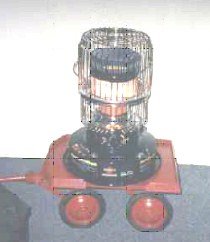
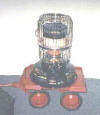
This cart was built by removing the
bed from a small wagon and replacing it with a sheet of
plywood. Molding was used for the edges. The wagon
bed was rusted out and the wagon discarded, but we
retrieved it from the recycling bin. The wheels
needed to be removed, the axles polished with emery
cloth, then greased. Now it rolls easily.
|
|
|
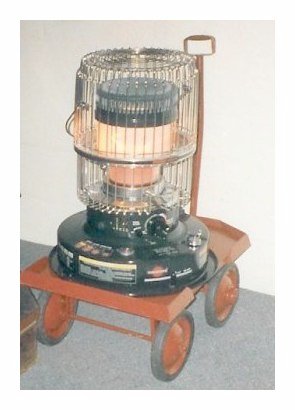
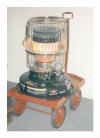
A view of the cart from the rear. The
bed is 17" by 24" long, and will hold every kerosene
heater I have, but the molding trim had to be left off
the middle of the sides because the DC-100 is 19" wide,
as you can see. Cost of this cart? Nothing. Scrap
wood was used, and the wagon was free from the "Sanitary
Landfill."
|
|
|
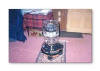
This cart is the base tank of a shop
vac which had been discarded. I cut off the tank
just above the wheel supports, bolted on a piece of thin
plywood, and 2 rubber snubbers hold the heater securely
to the base.
|
|
|
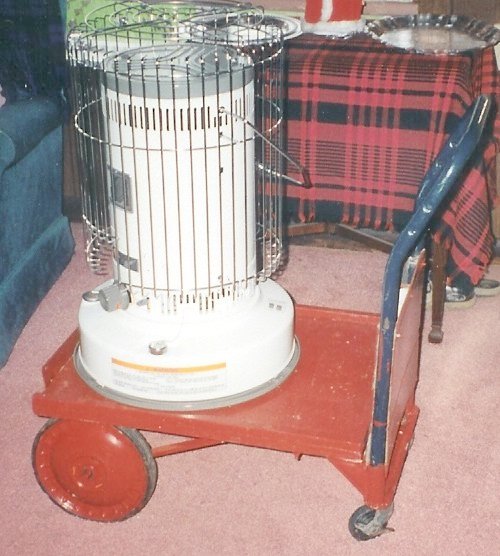
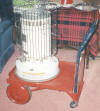
This cart actually cost some something
- $9.99 on sale from a hardware store. It is a
convertible hand truck/cart, with a sheet of 5/8" plywood
(19 1/2" x 23 3/4") bolted to the base, with 1" molding
on each side. Here it holds a WC-105 type N. In the
summer, this cart is used for moving honey supers from
the hives to my pickup.
|
|
|
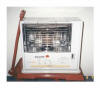
Here is a Heat Mate HMHR 1101 radiant
heater on the wagon. The wagon was built 24" long
to handle any of my radiant heaters. A Corona SX-2e
is only 17" wide, but a Toyostove RCA-87 is 23" wide. The
Corona SX-2e is 12" deep, the other radiant heaters
10".
|
|
|
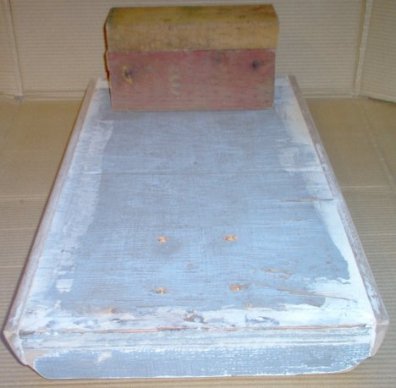
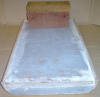
This is the base of a cart I built for
the Heat Mate HMHR 1101 and Corona SX-2E radiant heaters
- not for the wider Toyotomi radiants. I used an old
piece of 3/4" plywood, put on side rails, then caulked
them. Note the block at the end to hold the rear
axle assembly. The inside measurements are very minimal
at 12 1/2" x 21 1/2".
|
|
|
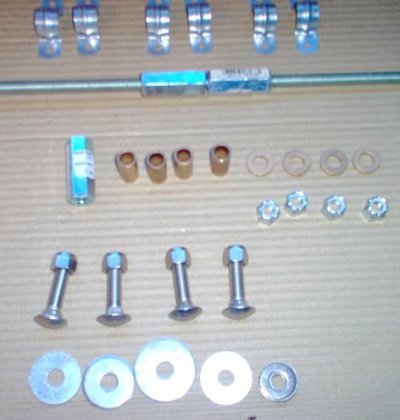
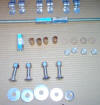
The parts needed for the rear axle
assembly: long 3/8" threaded rod, connecter nuts,
3/8" to 1/2" bronze sleeve bearings, 3/8" bronze thrust
bearings, 1/2" conduit clamps (back), and 4 stove bolts
for attaching the front swivel wheel. The wheels (below)
were from a lawn mower, and were salvaged from the a
recycle bin. Very low cost cart!
|
|
|
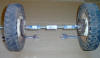
The rear axle assembly ready for
fastening to the block on the base. After attachment, the
cart can be checked for level, a plywood shim added to
the block if necessary, then the axle cleaned and
painted.
|
|
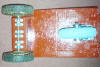
|
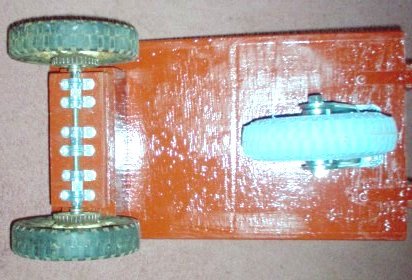
Bottom of the cart, with wheels
attached. The conduit clamps fit over the connecter
nuts and hold the axle securely. Now it can be
removed and painted. I used a blue "non marking"
caster wheel deliberately.
|
|
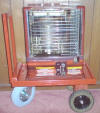
|
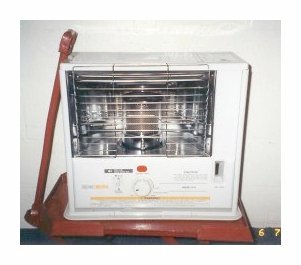
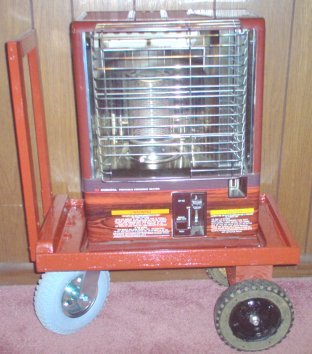
The finished cart, holding a Corona
SX-2E radiant heater. This cart is the absolute
minimum size (12 1/2 x 21 1/2") to hold a Corona or Heat
Mate radiant with the bails removed. The narrow width
make the cart a little tippy, but it will only be used
indoors on level floors. The caulked molding edges ensure
that any fuel spills will be contained in the cart and
can easily be cleaned up.
|
|
UTILITY
CARTS
Utility carts are
often used on uneven ground, so larger wheels make travel
much easier, and three wheels, with a caster wheel in front, allows them to
maintain a stable platform even if the ground is not
level.
|
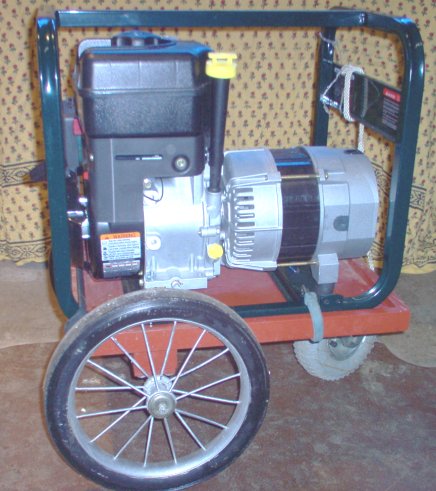 |
This cart for a 3,500 watt generator
was made by using a piece of 5/8" plywood, a 7" caster
wheel for the front, and recycled spoked wheels from a
discarded child's tricycle for the rear. It will
pull easily over rough ground. Note that the pull
cord is on the back end which is stable to lateral
movement. If the pull cord was over the caster
wheel it would not work very well!
|
|
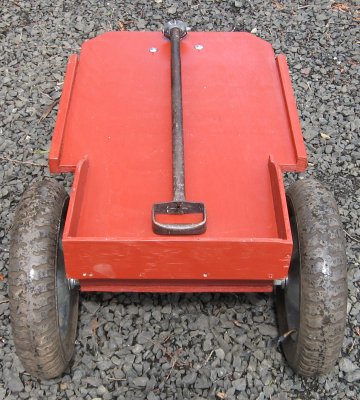
|
I needed a cart for carrying heavy
loads over a gravel driveway, up and down ramps and
through doorways. The result is a 32" long cart
with a width at the rear axle of 24", the maximum width
and length for conveniently traversing a hallway and
going through doors at an angle. I used a 5/8"
piece of plywood for the base, 1 x 2" stock for the side
rails, and 3/8" plywood for the rear "fenders." The
pull handle was salvaged from an old discarded wagon.
|
|
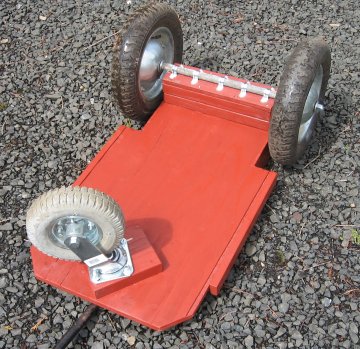
|
Here is the cart upside down.
The front has a 7" swivel caster wheel mounted on a piece
of 1 x 6. The rear wheels are 14" high, so I
dropped the axle 3 1/2" with two 2 x 4's and a piece of
1/2" plywood, resulting in a level platform. I
could have placed the 14" rear wheels completely under
the cart, but the center of gravity would have been too
high and the cart too tippy on hillsides.
|
|
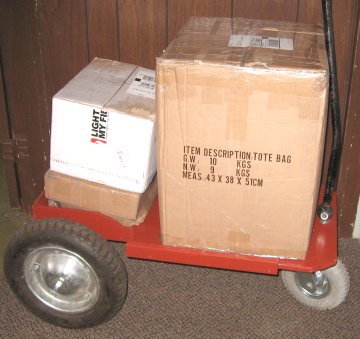
|
Here is the finished cart. The
UPS driver just came with about a hundred pounds of
freight. The big box easily fit inside the wider
rails in the front of the cart, while the heavy boxes of
steel EOD Breacher Bars
are directly over the rear axle. The cart easily
moved over the gravel driveway and into the house.
|
|
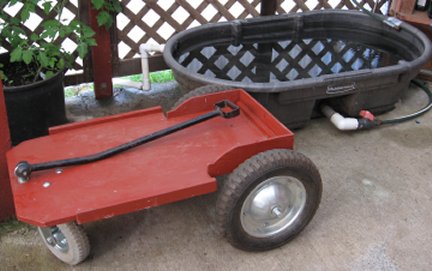
|
Another view of the new cart,
unloaded. In the background is an 80 gallon
Rubbermaid stock tank. The tank is filled by using a
diverter a downspout, filling the tank with
rainwater. The outflow valve I installed to avoid
sloshing over the end and having a wet patio. |
|
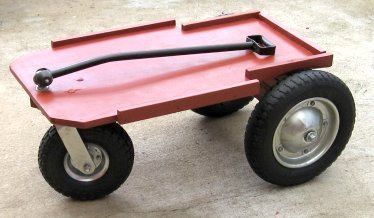
|
Travel over rough ground and gravel
made the 7" caster wheel chatter, so I replaced it with a
10" caster wheel. That meant I had to lower the
rear axle by 2" to make the bed level. Now the cart
practically rolls by itself!
|
|
|
|
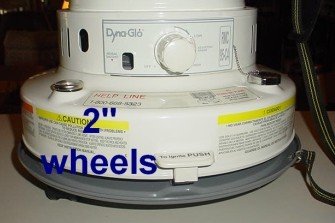
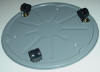
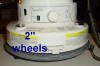
Jim
McFarland saw this cart page and came up with his own
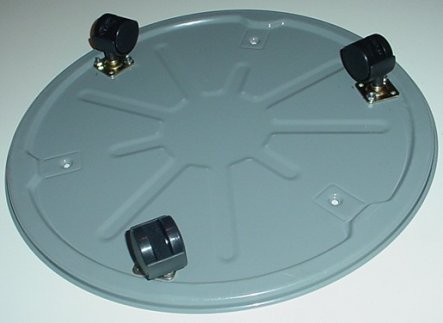
idea (OK, his wife did.). He bolted 2" caster
wheels directly to the base of his Dyna-Glo heater!
Very clever. It pulls easily over carpets with the
inexpensive 2" wide caster wheels.
|
Site
Index
Related subjects:
Kerosene
heaters:
Kerosene Stoves,
Lanterns and Ovens:
Kerosene, The
Fuel, and Storage Tanks
|
|
|