|
A guide to self reliant living |
||||
|
6. Kerosene heaters and cookers
12.
Electrical; generators
Miles Stair's SURVIVAL
Miles Stair's
SURVIVAL
Except for my Survival Shop and Wick Shop, all ads on this web site are placed by Google. I have no control over the ads nor can I endorse what is not mine. All of the information on this web site is completely free of charge. Miles Stair. Aug. 20, 2009 This web site is now available on CD in Adobe 7.0 for only $13.95. |
9. Communications
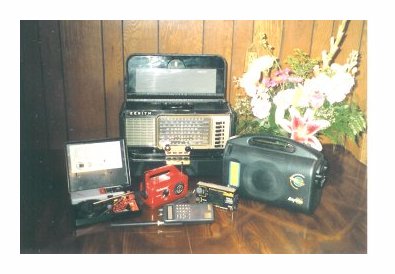
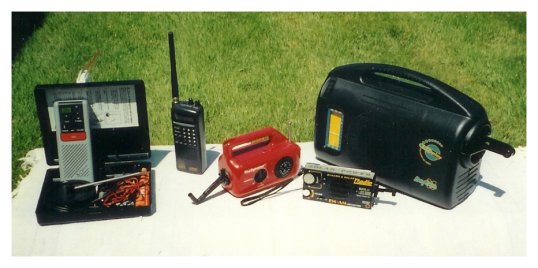
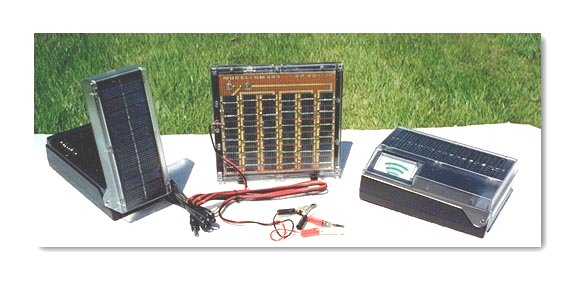
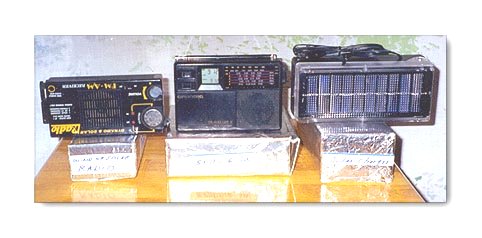
Miles has everything from shortwave to wind-up radios and scanners -- reliable communications will be crucial in the days ahead. Clockwise from back: 1953 Zenith TransOceanic; classic BayGen; small Solar and windup AM-FM radio (black), Uniden Bearcat 30 channel programmable scanner (laying on its side); red "Dynamo" wind up AM-FM & flashlight; and left, Cobra hand held 40 channel CB with portable antenna and power cord in fitted case. By Miles Stair We are living in an age of instant communication from radio to internet, telephone, not to mention television and newspapers. We are a media informed society. The sudden lack of information resulting from virtually any national or world wide catastrophe will be as startling and demoralizing as any other deprivation. We need information...we crave it. Most important, in any disaster situation we must be able to receive all the information possible in order to maximize our protection to better survive the ordeal. Emergency communications can be broken down into several categories: sending and receiving, or receiving only. SENDING AND RECEIVING For long distance sending and receiving, only "ham" radios will work. Unfortunately, this is not the place for a discussion of them, as the available information easily fills many books. If you need this information, search the web. There are ham radio's available that are fitted into a small suitcase, one side of which is composed of a solar panel with gel cell batteries behind the panel. These are expensive, need a long antenna array to work properly, and require a good deal of practice and skill to operate reliably. Those who like to experiment may find that a ground antenna will work instead of a highly visible tall antenna tower. Short range sending and receiving is now the province of FRS/GMRS radios. In the past few years new models have become available which are reliable, inexpensive, and charge from both 110 and 12 volt power sources. The difference in range between the 4 and 5 watt units is not great, but the price difference is! A small GMRS radio will enable one to coordinate communications (and therefore actions) with neighbors and friends. Be sure to set each unit to an unusual frequency, say channel 18 - 1, so everyone within distance can send and receive easily. The distance limitation of the units depends considerably on the terrain. One sharp mountain ridge blocks the signal, even though a 4 watt unit says they are good for 12 miles or so, and a 5 watt unit up to 15 miles, as that measurement is across flat ground. With low ridge lines, reliable transmission is limited to about 4 or 5 miles...but for short range communications, that is enough for use by "lookouts." For medium range sending and receiving, portable hand held CB units are relatively inexpensive, have a range of at least 5 miles, and operate off a 12 volt DC battery source. The battery may be recharged with a solar panel. For "citizen patrols," the CB radio concept is ideal. With 40 channels available, it is possible to switch frequencies on the hour, for example, to lessen the chance of alerting the wrong people of the intended consequences of their being spotted. Just remember that anyone, even the bad guys, can listen in and therefore know what is being said. RADIOS FOR RECEIVING ONLY There is a virtually unlimited variety of radios available for AM, FM and SW reception. In addition, hand held scanners are available which will scan virtually all available civil and military channels except the cell phone frequencies. The best information, of course, will come from sources outside our country, and that means listening to shortwave broadcasts at night. Knowing which frequencies to listen for on shortwave gets complicated, so a shortwave frequency guide is a big help. For local scanning with a hand held scanner, check the scanner frequency guide for helpful information. We need to limit the selection of radios to those which are self-powered or operate off batteries which can be recharged in a solar charger, as depending upon 110 volt AC power from the normal utility grid won't work when power doesn't or is down permanently. The radio above, for example, will last about 150 hours on a set of recharged NiMH "AA" batteries, is tiny and has incredible reception, which is why I carry it here for sale. Of all my radios (see photo at top), this is the one I use the most. Radios with a built in generator are relatively common. The "Dynamo" is inexpensive, receives AM and FM only, and the generator when hand cranked charges a NiCad battery pack similar to those in cordless telephones. The red colored "Dynamo" has adequate reception, is relatively sturdy, and the sound quality from the speaker is clear enough for prolonged listening. I keep a spare battery pack from a cordless phone always available with mine, as without a battery pack the Dynamo won't receive. The Dynamo does not have a ferrite loop AM antenna: the main extendable antenna is also used for AM. This is a distinct advantage, as a separate, longer antenna may be used, connected to the Dynamo's antenna with a small alligator clip, and reception is markedly improved. I have had a Dynamo for almost 15 years now, and consider it a good back up unit for emergency use.
The smaller, black "Solar, Dynamo" radio has a small solar panel on top and a rather flimsy crank handle for a generator. An advantage is that they will operate off two AA batteries, which are far more common than the battery pack required by the "Dynamo" radio. Reception is poor and sound quality abysmal. After a lot of experimentation, I have found the reliability of the GP-4L radio and a solar battery charger to be a better combination than a small wind up radio, at about the same price as a wind up radio alone. And, the reception is the same as the vastly larger BayGen wind up radio. For years, the finest reception and quality for AM, FM and shortwave available before 2005 came from the original, or "classic," BayGen radio. (Now, the tiny GP-4L Survival Radio is 1/10th the price and 1/100th the size and weight!) The South African made BayGen radio used a hand crank to wind a flat spring, similar to the turn of the century Regina music boxes. Once wound, the spring unwinds slowly, turning a generator which operates the radio: there are no batteries in the system. The spring winding mechanism is rated as good for 5000 cycles, so they will last for a considerable amount of time. The BayGen has a large transformer built into the system, so it will operate on any DC power input from 3 to 9 volts. For listening in daylight hours, a solar charger with a pig tail will operate the radio just fine, so the cranking mechanism need not be used until dark. Even then, if the spring breaks or the generator fails, the radio can be used at night by plugging in a Recoton battery adapter (see #11, Home Built Items, for details) from a 12 volt DC auto battery and stepping down the output to 7.5 volts or so, and the BayGen operates happily.
At about eight pounds, nobody could call the classic BayGen a really portable radio. But the reception and sound quality are very high, as is the reliability. Newer BayGen2 radios made in China have been known to break more frequently than the classic South African unit, so even though they are smaller, lighter and less expensive, I prefer the classic BayGen. To give you an example of their outstanding reception, I have been able to pick up BBC AM from Alberta, Canada, here in southern Oregon! Shortwave reception is also outstanding, particularly with a windup extension antenna strung up along the top of a window frame. Larger battery operated radios also work very well for emergencies. The excellent GE Super III AM and FM radio runs on six "D" NiCad's for months at a time. Reception with the super heterodyne system is excellent, and sound quality is above average. Quality of the unit is only fair, though: I had to replace the on/off push switch with a Radio Shack toggle switch, but that was after many years of use. The disadvantage of operating from six "D" batteries is apparent: solar charger require 9 to 12 hours to recharge a pair of NiCad's, so it is imperative to have a large quantity of spare NiCad's and keep some charging all the time, so six fully charged batteries will be available when needed. See Choosing a Survival Radio, by New England Gardener.
SCANNERS such as the Uniden BC80XLT have 50 programmable channels, but other, less expensive models with 30 programmable channels will work just as well (I have a 30 channel 10 band Uniden Bearcat scanner, for example, that cost only $60 from Damark). They can also be set to scan "ranges" of frequencies (all but the cell phone frequencies), so you can listen in to all of the police, fire, or most military communications. This feature is most desirable, as many of the emergency radios now are frequency agile: they send on one frequency and receive on another. By being able to scan the entire range of frequencies you can listen in on both sides of the conversation! My Uniden operates off four AA NiCad's, and runs for a long time before requiring recharging. It can also be operated off the from a Recoton battery adaptor and a 12 volt battery, or actually straight 12 volt DC input, if needed. Being small, hand held portables, they consume their power input in sips that may be supplied by NiCad batteries, whereas the larger desktop scanners are virtually all dependent upon a 110 volt source.
A Faraday Cage (below each radio above) is mighty cheap insurance to make sure your radio stays in operating condition. FARADAY CAGES (see #11, Home Built Items) are virtually mandatory for the radios mentioned above. Why? Because these radios are meant to be used in an emergency, and unless they are protected against electromagnetic pulse bursts (EMP), the electronics can be fried, and then they are useless. Old tube type radios such as the Zenith TransOceanic are not susceptible to EMP to any great degree, but do have distinct disadvantages. While designed to operate from a battery pack, the batteries are simply not available now. Also, the tubes are getting very rare and expensive. I have a 1953 Zenith TransOceanic and love it, but the darn thing is huge, heavy, and it requires 110 volt input to operate. WHEN ALL ELSE FAILS it is still possible to have a neighborhood communication "alert" system just like the old days, using a loud bell and a known code for the number of chimes (1 chime = alert; 2 = major alert; 3 = immediate danger, etc). Large brass bells are a thing of the past or extremely expensive, cast iron bells are fragile and mostly for "atmosphere" and looks, but you can build a good bell yourself. The steel used in 5 or 7 gallon propane tanks is of high quality, and the older tanks which are often available for free are very thick and strong. Removing the valves and flooding the tank with water removes any danger of residual propane gas exploding. Then the top of the tank may be cut off and the tank hung upside down by the base. Struck with a wooden mallet, these "bells" have a remarkably loud sound which carries for a considerable distance.
|
|
||