|
A guide to self reliant living |
|||||||
|
6. Kerosene heaters and cookers 12.
Electrical; generators
Miles Stair's SURVIVAL
Miles Stair's
SURVIVAL |
A guide
to self reliant living
|
1. Food |
2. Manna Meals |
3. Water |
4.
Sanitation | 5. Medical, health
|
| 6. Kerosene heaters and cookers | 7. Lighting | 8. Wood cooking and heating | | 9. Communications | 10. Essential Tools | 11. Home built items | | 12. Electrical; generators and power | 13. War preparedness | 14. Gardening |
3.
Water
By Miles Stair Bread may be the staff of life, but water is absolutely critical to human existence. Those caught off guard by events, in an emergency evacuation, or in a catastrophic situation will need to FIND water and must know how to filter and purify it under relatively primitive conditions. Those issues are addressed in an article by Jiyani. I feel that it is always better to be prepared prior to any emergency. Life is stressful enough under emergency conditions without unneeded complications caused by a lack of foresight, planning, and preparations. Water can be stored in 2 liter pop bottles, drums or barrels, or in large tanks. The containers must be sterilized prior to use, then the water must be disinfected for safety - two very different things entirely. An emergency water filter should be made if your survival plans include evacuation to a remote area where you would be dependent upon an open source of water, such as a stream, river or lake.
Don't forget that farm creatures also require a reliable source of water, and that can be a simple miniature of the system for the house. I use such a system for chicken water with an automatic float bowl which does not overflow, and the same system can be used with stock watering tanks with a float lever shut off valve.
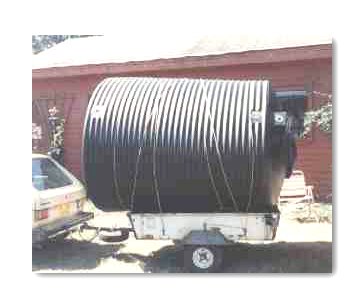
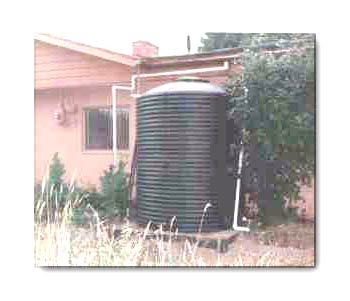
A very important part of long term survival preparations should be a method of collecting water, filtering it, then delivering it to the house under gravity flow pressure. A rainwater collection system that can passively collect water, filter it, and deliver the water via gravity flow to your home is an excellent survival system. This system is detailed in my booklet, Rain Water Collection & Storage, complete with photographs and a list of the plumbing parts required. Order the booklet here. If required, water can be pumped with a gravity flow ram pump or an RV 12 volt pump powered by a 12 volt battery which is recharged with a solar panel. You can be creative here. Remember, most water delivery systems are for irrigation, and therefore they are rated in "GPM," or gallons per minute. For normal household consumption, however, we are concerned mostly with "GD," or gallons per day. Anything over 500 gallons per day is more than adequate for household use, as it is possible to use less than 100 gallons per day quite easily if you're careful.
"Powershack" Powershack pump A small solar system for remote livestock watering tanks, for example, will deliver 960 gallons per day with a 24 volt submersible pump from a depth of 230 feet, but only if the sun is bright, the solar panel is clean, and everything else is in perfect order. Cut that production in half for an average of 500 gallons per day, and you would still have more than enough for household use on a continual basis. Obviously the whole system depends upon a well, and the shallower the well, the better. So it then becomes a question of storage and delivery, as always. To make it easier on the solar system and the batteries that work the pump, the solar livestock system should fill a storage tank of at least 1250 gallons, and that tank should be elevated at least 15 feet above the house if possible, and 30 feet of elevation is even better. For every foot of elevation, the theoretical pressure is 0.54 PSI, but with line loss (friction), a working average is 0.50 PSI per foot of elevation. Therefore, a storage tank 15 feet above the level of the plumbing in the house will deliver 7.5 PSI, which is adequate...not more, certainly, but the water will flow. The storage tank can be filled during sunny days, then drawn down on overcast days and at night, thus conserving the battery system, and potentially even eliminating it completely except as a moderator of the voltage going to the pump. Check with dealers such as www.powershacks.com for "remote solar livestock watering kits." These systems are well worth considering if you live in a dry area lacking in sufficient rainfall for domestic water purposes, and you can have a well drilled for your own drinking water. Thus life could go on, perhaps not entirely normal or what we are accustomed to, but certainly not with great difficulty or scarcity. My booklet, "Rainwater Collection," is an actual illustration of the system in use at our home. Included are photo's of the critical subsystems, directions for installation, and a complete parts list of all the items needed to build a rainwater collection, filtration, storage and delivery system. This system could easily be used in dry, desert country with the addition of a small, low recovery well and solar pump....the idea is to have stored water that can be delivered by gravity flow to the house through the normal house plumbing, and work just fine in the absence of the normal utility grid, or even a noisy, auxiliary generator to run a water pump.
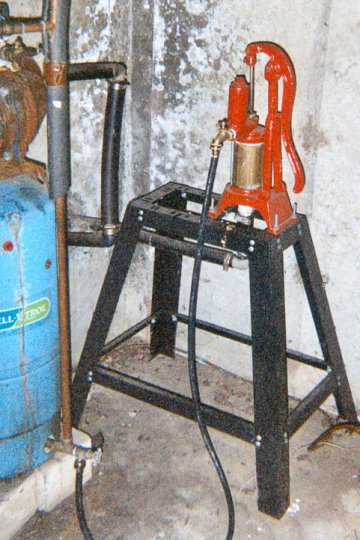
See my hand water pump, an Oasis sealed pitcher pump. It is not finished and ready for winter, but it works! New England Gardener has an excellent illustrated article on his hand pump at his Seed for Security website.
|
1. Food |
2. Manna Meals |
3. Water |
4.
Sanitation | 5. Medical, health
|
| 6. Kerosene heaters and cookers | 7. Lighting | 8. Wood cooking and heating | | 9. Communications | 10. Essential Tools | 11. Home built items | | 12. Electrical; generators and power | 13. War preparedness | 14. Gardening | |
|
|||||