|
A guide to self reliant living |
||||||||||||||||||
|
6. Kerosene heaters and cookers
12.
Electrical; generators
Miles Stair's SURVIVAL
Miles Stair's
SURVIVAL
|
8. Wood Cooking & Heating
By
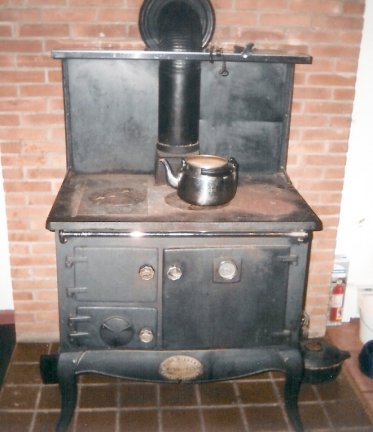
Miles Stair Ultimately, we will all probably be cooking and heating with wood stoves. But in any type of emergency scenario, it would be much safer to cook and heat with kerosene stoves and heaters. Wood stoves radiate a huge thermal plume visible to infrared detectors, so anyone with night vision goggles, or anyone looking down from a helicopter or airplane, would definitely be able to spot your location in a flash. During daylight hours, the smoke is visible for miles, sort of like a neon sign advertising "free hot food here for the taking." No thanks. It is better to keep out of sight, out of mind until the dust settles, and use kerosene heaters and cookers. Before a wood stove is used, the chimney should be checked for leaks, as the last thing you need or want is to have wood smoke in the house or worse, a fire. DO NOT USE WOOD TO TEST A STOVE AND CHIMNEY!!! It is very difficult to put out a wood fire, and the object is to test the chimney with smoke, not fire. Crumpled up sheets of newspaper burn quickly but put out voluminous quantities of white smoke. If there is a leak, it will be readily visible. Cold air is dense and heavy, and sometimes a column of cold air inside a stovepipe will prevent lighter, warm air from raising up through the chimney. This is a particular problem with fireplace inserts which use the fireplace chimney as a flue, as the brick or masonry chimney has a considerably greater volume than a stovepipe in which to trap cold, dense air. This problem leads to a stove smoking when first lit, and if a wood fire is started, a lot of smelly wood smoke billows into the house. The stovepipe or chimney can be warmed by burning a few crumpled sheets of newspaper, then a wood fire can be built without fear of smoking up the house. Cooking with wood stoves is pretty tricky. That was an art handed down from mother to daughter for generations! The instruction manual for my Monarch Wood-Electric Range is quite detailed. Regulating the temperature of a real, honest to goodness wood cooking range is hard enough: regulating the cooking surface temperature of a makeshift stove is much more difficult. Generally, the use of trivets to elevate the cooking pots and pans above the stove surface will allow more air circulation and lower the temperature, and that is easier to regulate than the temperature of the stove.
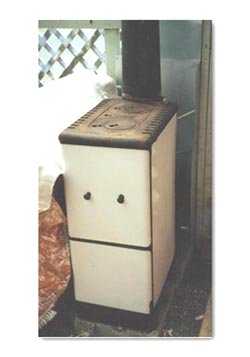
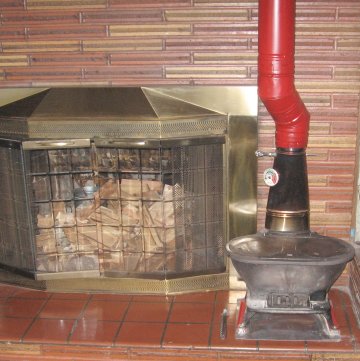
It is now almost impossible to find real wood cook stoves. Kitchen Queen wood cook stoves are made in Indiana. Some fabulous old stoves are being rebuilt. So-called "trash burners" (photo above) can still be found and can be used for cooking. Some types of fireplace insert stoves have a small cooking surface, but the availability of them varies greatly by locality. Wood heating stoves often have a small cooking surface, but since their primary design function is to heat, indoor cooking in the summer is extremely uncomfortable. In that case, a small wood cook stove located out of the living area, even in a greenhouse, would be a much better idea. And you will need non-electric tools and equipment for cooking. [Update February 21, 2010. Obadiah's Woodstoves in Montana is offering some very interesting looking woodstoves which look somewhat like the Stanley woodstove above. They have a full range of models available. They say their stoves are built by the Amish.] For those on a budget, an extremely good thermal mass wood heating stove can be assembled at a very good price. Once of the great advantages of this type of stove is that it does not have to be assembled and installed until it is actually needed. All you need are all the parts and pieces, the stove pipe, etc, assemble it now just be sure you are not missing any important items, then disassemble it and store in an outbuilding, shop, whatever. No matter what type of wood stove you use, the proper chimney cleaning and ash removal equipment is required, and standard safety precautions must be enforced. Most hardware stores carry 6" and 8" round chimney brushes and segmented rods to clean the longest chimney. Sept. 18, 2006. Note from reader Sam: From bitter experience I can offer a couple of safety hints: secure each joint with three small screws spaced 120" apart, the next thing is use "T"s instead of elbows, This will make cleaning out creosote and soot much easier and quicker. Thanks for all the good information offered on your web sits. Sam [Sam is right, and this is so obvious that I overlooked mentioning it. My stove pipes are secured with three small sheet metal screws, and "T's" are far better than 90 degree elbows...how do you remove creosote from an elbow? Pre-drill all holes in stovepipe!]
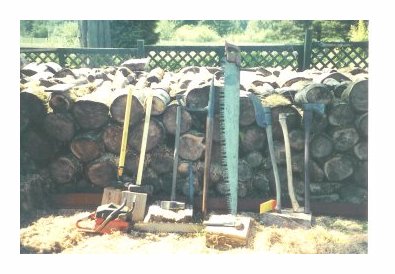
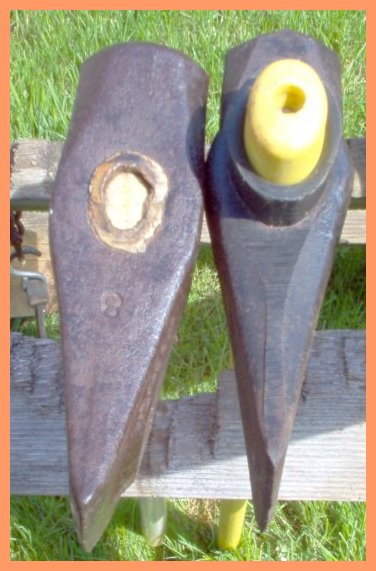
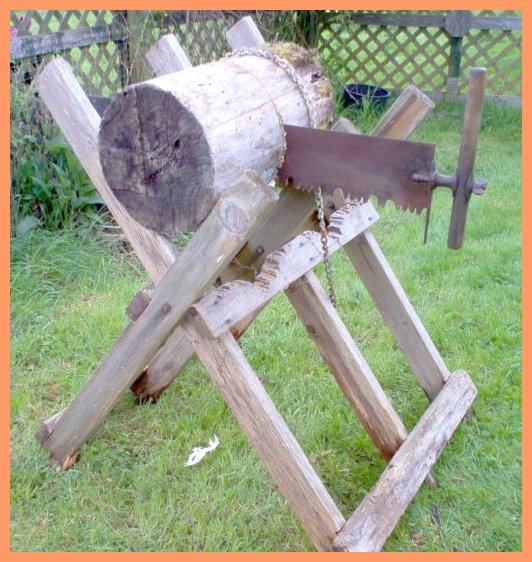
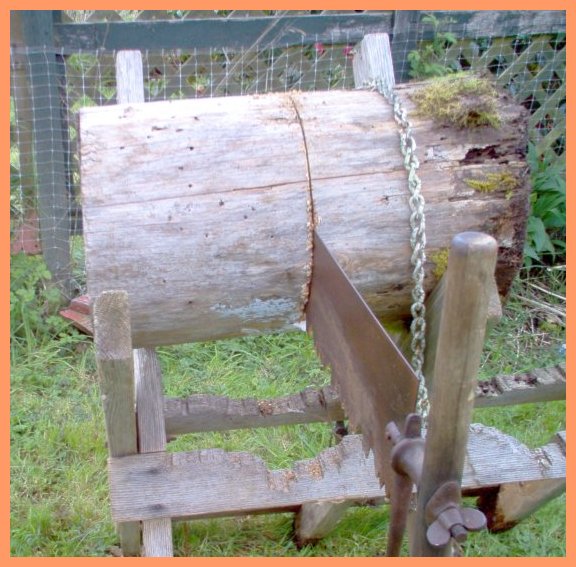
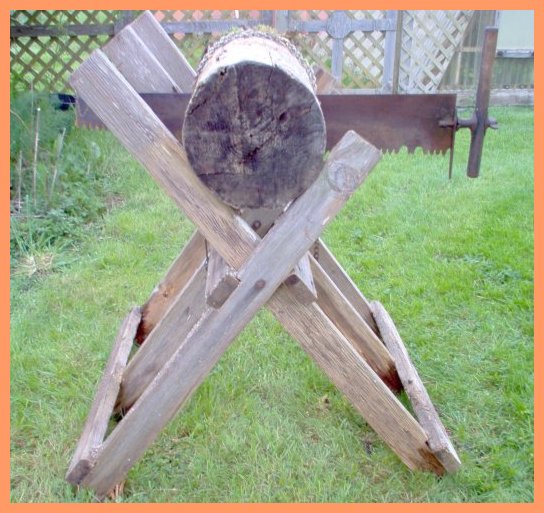
Wood stoves, of course, require wood fuel. What kind of wood? That depends upon the locality. The ideal is a mixture of hard and soft woods. Those to avoid would be dogwood, wild cherry, or any pithy soft woods, as they do not store well for extended periods of time. Virtually any fruit wood makes a great fire, and can also be used in a smoke house for curing meats. And, of course, you will need woodcutting tools. The firewood must be cut, split and stored properly. And that must be done prior to any anticipated use, as the wood must be seasoned (not "green") and also be dry to burn efficiently. This is all manual labor - hard work! - but you should have at least a cord of wood ready for use at any time. Always wear safety glasses when cutting and splitting wood. The eyes you save could be your own. You will need the proper tools for this, of course, and they must be on hand well before a time of emergency -- or you will not find them at all. It is still possible to find crosscut saws in antique and junque shops, as the files to sharpen them are available in most hardware stores.
Even though a maul has one flat side, DO NOT use it to drive wedges to split chunks of wood. Mauls are tempered to hold an edge, and are not designed for steel-to-steel contact. The steel splinters can put out eyes dozens of feet away! Sledgehammers are tempered and annealed for steel-to-steel contact, and are the proper tool to use for driving wedges. There is a good reason why different tools are used for different purposes! For those who want more information, there is an Internet forum devoted to wood_stove use. http://www.hearth.com/econtent/index.php/forums/ One source of cast iron stoves is http://www.vogelzang.com/cast-iron-stoves.htm Note from reader Michael P., July.27.08: "I saw one comment on your web site about old fashioned wood cook stoves being very hard to find. I live in western Massachusetts not far from Richard's stove shop. Richard "Stove Black" Richardson has been restoring and selling old wood cook stoves for decades (he also restores and sells vintage wood stoves designed for heating). I bought a wood cook stove from him back in the 1980s. He is very knowledgeable, does quality work, and I believe the prices (while expensive) are reasonable for the merchandise he sells. The length of time he has been in business speaks for itself. His web site is at: www.goodtimestove.com Note from reader W. Schroeder, April 20, 2011
I
just read your section on woodstoves... We
heat with wood and currently have both the
Bakers Choice and the Pioneer Maid offered by
Obadiahs. We have used the Baker's Choice for
quite a few years and it is a very efficient
and functional stove. It is radiant heat and
so I would suggest locating it in a central
position in your house. The layout of our
home requires two stoves, the Pioneer Maid is
bigger and if someone is choosing between the
two I would suggest the Maid. The oven is
larger and so is the cook-top. It puts out
the same amount of heat as the Baker's does,
however, the water reservoir is larger and in
my opinion better situated for ease of use.
Our Maid was just purchased, however several
friends have one and have used it for heat
and cooking for a number of years. For wood cooking stoves, try http://stovesandmore.com/
| 1.
Food | 2.
Manna Meals |
3.
Water |
4. Sanitation |
5. Medical, health |
| 6. Kerosene heaters and cookers | 7. Lighting | 8. Wood cooking and heating | | 9. Communications | 10. Essential Tools | 11. Home built items | | 12. Electrical; generators and power | 13. War preparedness | 14. Gardening |
RELATED LINKS:
|
|
||||||||||||||||