|
A guide to self reliant living |
|||||||||
|
6. Kerosene heaters and cookers
12.
Electrical; generators
Miles Stair's SURVIVAL
Miles Stair's
SURVIVAL
|
1.
Basic Food Storage
By Miles Stair Many people are now considering the need of food and related preparation as an antidote for avoiding starvation. You might find this statement astounding, given the abundance of food to be purchased in our prosperous times, but I will put a question to you: Where will you buy food when you refuse the Mark of the Beast? When irrational weather changes caused by anomalies of the sun bring severe drought and famine stalks the land, will you be prepared? When hyperinflation shrinks the value of the dollar to pennies, will you have a "turnip winter," or survive well with your own resources?
These are legitimate concerns for all, especially the persons on fixed incomes or those existing on already overstretched wages. God helps those who help themselves. You can and should prepare, no matter how powerless you might feel considering the magnitude of what looms before us. Even those with little storage space or living in an apartment can prepare! And be prepared for incredible increases in the price of basic foods - a real food shock, as the stockpiles of grains are now at record lows. See some fabulous photos of an autumn harvest from Seed for Security. [In the context of food preparations, in this article I will essentially only cover purchased foodstuffs, not what you can grow yourself. Conventional gardening is covered in another section, as is greenhouse gardening and a number of articles linked to those pages. Growing your own food supplies takes a lot of work and time. For example, it took me two years to make a sandwich that was completely my own. The first year I grew white wheat from seed which I purchased. The second year I was able to grow wheat from my own surplus seed stock and grind it for flour. The mayonnaise had to be made with eggs from chickens I raised. The "hamburger" had to be ground from surplus male dairy goat meat, and the cheese made from twice daily milking of those Alpine dairy goats. That takes more time and effort than most people have right now. So buying food stocks is the only viable alternative.
[ UPDATE JUNE 17, 2012. For the past 12 years on this website I have shown you how to build your own storage food supplies. That information is still here - see the links on the left side of this page. Now, however, it may well be too late to begin the slow accumulation of a supply of stored food. A jump start - a basic supply - is needed now. That supply should be supplemented with bulk foods such as canned food, whole grain wheat and rice, hamburger rocks, plus garden greens. But the safety and security of long term, prepared stored food should now be considered virtually a "must have" item. On the right side of this page are advertisements for two Survival Food companies. Both are recommended. They have the stock on hand for immediate shipment and their prices are reasonable. Please take the time to compare what they have to offer and choose a good supply of their stored food. I have obviously been prepared for many years, but nevertheless purchased a nine month supply of food for four people just to have it on hand. With a 25 year shelf life they are a very smart investment for your future. ]
Let us see what can be done with a preparation budget of $300.00.
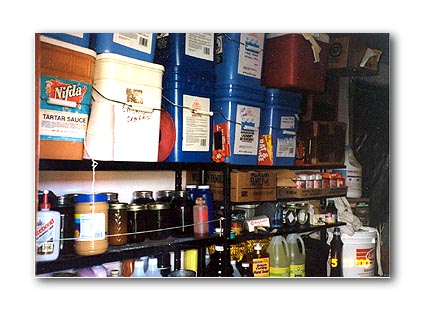
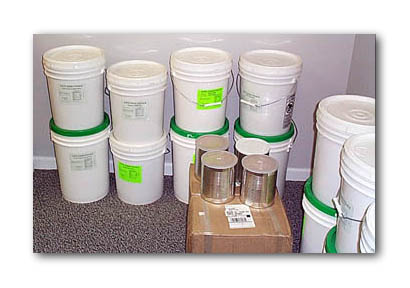
Beginning preparations of food storage should start with inexpensive, yet nourishing, bulk foods: rice, beans and wheat. These grains are inexpensive and can be safely stored for decades in 5 gallon buckets. Standard white pastry filling buckets may be found (used, but clean) for free or a nominal cost at bakeries and restaurants, but they are actually more like 4 gallon capacity. The strongest storage buckets are the green or blue pickle or relish versions, and these are taller and hold about 5 gallons. Even washed thoroughly, the vinegar aroma is still present, but will dissipate over a year and does no harm.
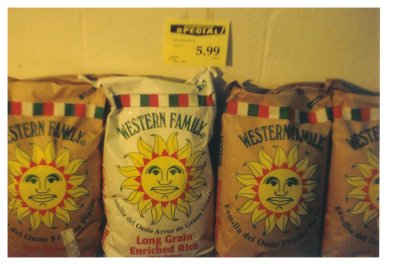
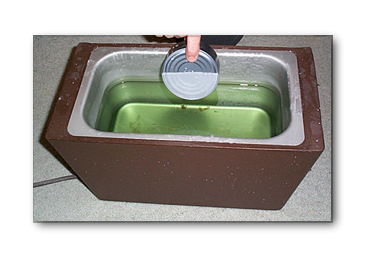
Rice may be purchased in 20 pound sacks for about $8.00 each, and pinto beans (p. vulgaris) are available in 25 pound sacks for about $12.50 per sack. Whole feed wheat sells for about $7.50 per 50 pound sack. To properly store grains in buckets, they must be completely filled. Three sacks of rice will fill two white pastry buckets, while 2 sacks of beans will fill 3 buckets. Two 50 pound sacks of wheat will fill 3 buckets. So buying enough rice, beans or wheat in the quantities required for filled buckets will make life a lot easier - segmented buying, as it were - convenient for phased stockpiling. For example, begin with rice. It is available in 20 pound sacks at large grocery stores, as are large sacks of beans. For wheat, order from a nearby "Feed & Seed" country store. If you cannot lift the weight of the sacks, try to find a friend who will help you. Both rice and wheat can be stored in buckets for decades! Beans last only about three years, so rotate your stock! At this point we have used less than $65 of our $300 budget, and have 7 buckets full of more than 200 pounds of nutritious food. To this basic starch/filler food supply may be added cases of corn, cut green beans and peas. These may often be found on sale for 24 cents per can, or $6.00 per case of 24 each. To prevent rusting of the cans and therefore prolong shelf life, the cans should be waxed.
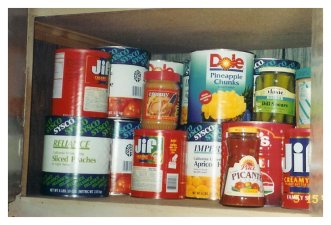
Now we need to add some protein to the storage foods. Cans of tuna or corned beef are nutritious and tasty. The tuna may often be found on sale for about 50 cents a can, the corned beef for about $1.50 per can. Three dozen cans of tuna and a dozen cans of corn beef consume approximately $35, so our total for food items is still less than $120.00. These cans should be coated in wax to prevent rust, and will last in storage for 5 to 7 years at least. The food listed above will keep the average family alive and healthy for months. The variety is not great, but that can be remedied by additions to the storage supply over the course of months.
But
what do you do with those bulk grains? The
pinto beans and rice may be cooked as is, but
the wheat needs to be ground or cracked. A
cereal identical to "ZOOM" can be made by
grinding the wheat kernels in a grain grinder
(mill) with the burrs not quite touching. Set
the burrs closer, so they barely touch when
turned "dry," and you can produce flour - and
thence bread. Dry corn may be ground for corn
meal, mush or muffins. [ www.NorthernTool.com
sometimes sells an Chinese version of the
grinder shown below, their item number
168670, for $22.99. If they are out,
Lehman's
Hardware has mill #37250 which is
made in Mexico.] This grinder has steel
burrs, so it can grind corn and beans as well
as wheat. Stone burrs get clogged when
grinding corn or beans, but do provide a
finer wheat flour.
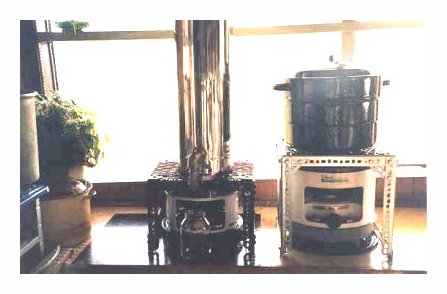
Of our budget of $300.00 we have used less than $120, so there is still enough left for the purchase of a grain grinder, a kerosene stove with which to cook, some kerosene lanterns (and wicks), and kerosene. You can do it! ADDITIONAL FOOD PRESERVATION PAGE LINKS Those who do not wish to store whole grains and purchase a grain grinder can store flour, but it does not last as long in storage as whole grains. Corn meal may be purchased in boxes, but for long term storage the boxes should be waxed.
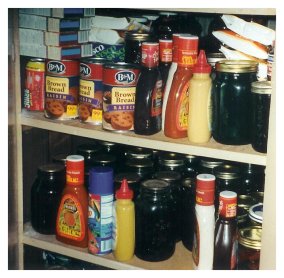
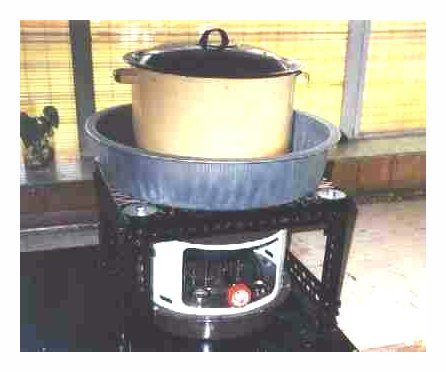
As an alternative to storing sugar, it is better to store honey. Ultimately, when electricity, and therefore refrigeration, is no longer reliable, it is possible to preserve meat the old fashioned way, by making pemmican, jerky, and smoking, covered here under Survival Meat Preserving. Part 1 covers Pemmican. Part 2 has instructions for making jerky. Part 3 show how to build and use a smoke house. Meat and vegetables may also be canned using a kerosene or wood stove as the heat source. Canning requires attention to detail, particularly knowing the correct length of time needed to properly process various foods: low acid vegetables and meat can take a long time to be done properly. Over the years, the USDA and canning jar makers have changed their recommendations for both the duration of time and the methods used in canning, as the "nanny" government and product liability lawyers have become involved in those recommendations. Canning requires that you pay attention, and that you have some guidelines to follow. The links below are to .pdf files from a 1948 Kerr canning book. I take no responsibility for any of the recommendations given for canning.
Those interested in home canning the old fashioned way are welcome in an egroup devoted to that particular topic - http://tech.groups.yahoo.com/group/southernsmallholder/?yguid=238877007 . (Please note this is a Christian group. Those who are offended by Christianity should look for help from atheists or agnostics as other people still have the right to associate with those whom they choose.) A shopping list will help with a planned, systematic food preparation program, so that all the food groups are included. Ultimately, as your preparations progress, you will want to compare what you have with the "How Much to Store?" lists of recommended quantities. USDA Home and Garden Bulletins which can be downloaded for free. Your tax dollars paid for them! Tons of information. -----------------------
|
|
|||||||