|
|
|||||||||||||||||||||||||||||||||||||||||||||||||||||||||||||||||||||||||||||||||||||||||||||||||
|
6. Kerosene heaters and cookers
12.
Electrical; generators
Miles Stair's
SURVIVAL
Miles Stair's
SURVIVAL |
KEROSENE FUEL PRIMER Kerosene defined - Red Dye Kerosene - Mineral Spirits - High Sulfur Kerosene - Jet Fuel - Water in Kerosene - Liquid Paraffin Lamp Oil - Kerosene Storage - Large Storage Tanks - Possible tax rebate for home use of clear kerosene
Daily reminders by our benevolent leaders on every danger imaginable has created a population afraid of almost everything. So it is with those new to kerosene as a fuel and kerosene-fueled heaters and cookers. But kerosene products have been around for over a century and are safe to use with only the usual precautions required for anything that generates heat.
Abraham Pineo Gesner (May 2,
1797 - April 29, 1864) was a Canadian physician and geologist
who invented kerosene. Although Ignacy
Lukasiewicz developed the modern kerosene
lamp, starting the world's oil industry,
Gesner is considered a primary founder.
Gesner was born in Cornwallis, Nova Scotia.
He died in Halifax, Nova Scotia.
Gesner's research in minerals resulted in his
1846 development of a process to refine a
liquid fuel from coal. His new discovery,
which he named kerosene, burned cleaner and
was less expensive than competing products,
such as whale oil. In 1850, Gesner created
the Kerosene Gaslight Company and began
installing lighting in the streets in Halifax
and other cities. By 1854, he had expanded to
the United States where he created the North
American Kerosene Gas Light Company at Long
Island, New York. Demand grew to where his
company's capacity to produce became a
problem, but the discovery of petroleum, from
which kerosene could be more easily produced,
solved the supply problem. Abraham Gesner
continued his research on fuels and wrote a
number of scientific studies concerning the
industry including an 1861 publication
titled, "A Practical Treatise on Coal,
Petroleum and Other Distilled Oils," which
became a standard reference in the field.
Eventually, Gesner's company was absorbed
into the petroleum monopoly, Standard Oil and
he returned to Halifax, where he was
appointed a Professor of Natural History at
Dalhousie University.[4][5] "Coal Oil" virtually ceased to exist. Lamps were still known as "oil lamps," of course, because they had been designed to burn coal oil. Coal is a mineral, and by crushing and steaming the coal, the "essence" of the coal was obtained, it's "spirit," in the form of an oil. And that became mineral spirits, a vastly more pure product for use in wick appliances. If from low sulfur content coal, it became "Low Odor Mineral Spirits." The Amish still use nothing but Low Odor Mineral Spirits in their center draft lamps.. On Jan. 15, 1885, Leonard Henkle patented the flame spreader which would make possible the efficient use of center draft lamps. The Henkle patent was purchased by Charles Upton. By the summer of 1884 Upton had standardized various sizes of lamps (0, 1, 2 and 3) and was selling lamps made for him by Edward Miller under the trade name Rochester Lamp Company. Those lamps were designed to burn coal oil - Low Odor Mineral Spirits. In 1888 the Cleveland Foundry Company
was formed. They manufactured a line of oil
lamp stoves, along with many lamp companies
such as
Bradley & Hubbard and
Miller. In 1894, the plant started
producing portable heaters. These
heaters used the "store
lamp" wick that had been standardized by
Rochester in 1884. In 1901 Francis Drury
approached John D. Rockefeller of
Cleveland, owner of Standard Oil Company. At
the time Standard Oil was delivering kerosene
to homes and businesses for use in kerosene
lamps. Rockefeller knew that with use of the
Drury Stove the demand for this kerosene
would increase substantially and it did.
Rockerfeller selected the company to design,
develop and manufacture for it a complete
line of stoves which were to be sold under
the name "Perfection" to dealers by a group
of 300 Standard Oil salesmen. This
arrangement was continued by other oil
companies. So, we have center draft lamps designed to burn coal oil, are called "oil lamps," and now were burning Standard Oil's "kerosene." Note the very careful wording - "center draft lamps." Low Odor Mineral Spirits should not be used in lanterns or flat wick lamps - just larger metal fount center draft lamps designed in the 1880's. The Aladdin mantle lamp was not designed until 1907 and was intended for use with kerosene. See more on Low Odor Mineral Spirits below. Propaganda. For a hundred years
or more, we have been conditioned to believe
that kerosene "oil" lamps are supposed
to burn "kerosene." And for the past 25
years, another layer of propaganda would have
us believe that only $20 per gallon "Liquid
Paraffin Lamp Oil" should be burned in
lamps. Bullpucky.
Kerosene is NOT like gasoline: it is a lubricant, not corrosive, not volatile, and extremely stable in storage. The specific gravity of kerosene is about 0.8, and its ignition point is more than 104 F. If you throw a match into a pool of kerosene it will put out the match. You can hold a match right up to the edge of a teaspoon half full of kerosene and it will not ignite (try that with gasoline and you will need to grow new eyebrows).
Kerosene may be safely stored in plastic containers, oil drums, old diesel tanks -- just about anything that doesn't leak. Kerosene should be stored in blue containers, as red indicates gasoline. Kerosene does expand and contract slightly with ambient temperatures, so steel tanks should be vented or have some "head space" left in the tank. Plastic containers are designed to have room for expansion, so they may be filled to the lowest edge of the fill hole safely. Ideally, kerosene should be stored under cover in a ventilated tank. Five gallon kerosene containers should be on secure shelving in an outside shed or barn - never in sunlight, as that quickly degrades the kerosene. Obviously you should not store flammable liquids in the home, as that would violate every fire insurance and code regulation that exists and a few new ones as well. To emphasize a point, kerosene containers should be blue so they cannot be confused with gasoline containers, which are red. The grade of kerosene required by modern kerosene appliances is No. 1-K, which can be either red or clear. The red dye was added by a Clinton Administration edict in July, 1998, so people using kerosene to fuel their diesel engine vehicles would be easy to spot by the police for not paying the road tax on motor fuels. Sure. Like a cop is going to siphon fuel out of your tank to check what color it is. It is just one more idiotic, unconstitutional edict (see the Tenth Amendment) we are stuck with. [A reader in Holland told me the police actually DO set up roadblocks and check the fuel color to make sure the road tax has been paid, so I guess we are lucky so far.] While on the subject of governmental interference, I should mention that we get the crud now for kerosene. When the fed burrorats insisted on low sulfur diesel for 18 wheelers, the govt workers forgot they cannot regulate nature or the market place. It's not like some bureaucrat can turn off the sulfur content of North Slope oil, nor is it likely that it would go unused because of the high sulfur content. So the market switched products to match the whims of the politically correct bureaucrats. Now, diesel engines get the sweet, light low-sulfur diesel (and they could not care less), while we get to burn high sulfur kerosene in our homes. And it's not just kerosene. Home heating fuel is now high sulfur crud. So instead of 18 wheelers belching sulfur dioxide, now it is emitted by every home in America that heats with oil. The amount of "oil" consumed remains the same, the amount of sulfur dioxide emitted remains the same, but enviro wacko's can marvel at how they changed things and "reduced emissions" when in fact the net effect is zero. Marvelous. Red dye or clear...is there a difference? Yes. Without a doubt. Red dye kerosene is usually delivered in bulk quantities by a fuel oil supplier, and is known in the trade as #1 stove oil. Clear 1-K kerosene in bulk quantities is very difficult to find in many areas of the country, AND it often costs at least a dollar a gallon more than red dye #1 stove oil (kerosene). There is no free lunch. The red dye kerosene requires more frequent dry burns, and in heaters with a short catalytic burner unit it does not burn as cleanly. Adding an eyedropper full (1/3rd teaspoon) of 91%+ alcohol per gallon of red dye kerosene helps to keep the wick cleaner. It may well shorten the life of the wick a little, but the savings in price compared to 1-K clear makes that a small cost indeed. Pure alcohol is available in most hardware stores - look for Shellac thinner or Denatured Alcohol. If you are using kerosene only for lamps, clear 1-K kerosene can be purchased in hardware stores for $8 or more per gallon -- but you will not be using enough of it to make much of a difference in cost. The clear will burn cleaner in lamps then red dye kero, and the wicks will last longer. NOTE: I have absolutely no agenda on lamp fuels. You can burn whatever the heck you wish to burn in your lamps. Some people seem to think that one fuel is so vastly superior to all others they will aggressively attack all other fuels. I refuse to engage them, nor will I get into a debate on the merits of their position. The information on this page is strictly my opinion. My only goal is clean burning, long wick life, and safe burning conditions. If you wish to burn expensive "Liquid Paraffin" and ruin the capillary action of the wick, or burn 1K kerosene and have rapid charring of the wick and therefore short wick life, that is fine with me - I will happily sell you new wicks. But I like long wick life, a bright light, as little charring of the wick top as possible, with a safe and inexpensive fuel. You may do as you wish as it is your lamp, your wick and your responsibility. Peace be with you. Go with God. Whatever happens it ain't my fault. The best fuel for metal font center draft lamps in my opinion is Low Odor Mineral Spirits, as it costs less than 1-K clear kerosene and burns unbelievably cleaner, so clean the wicks seldom even need to be trimmed. Some specialty center draft wicks are made for me in low quantities and are thus expensive, so this is an important factor! In center draft and Kosmos lamps (with metal fonts), you will be amazed at the quality of the burn and the lack of any char on the wick. Unlike kerosene which precipitates paraffin, Low Odor Mineral Spirits are absolutely pure and leave a font perfectly clean and clear. I was tipped on this fuel by the Amish, who have used it for decades for their "kerosene" lamps. I purchase Low Odor Mineral Spirits from my local True Value Hardware store, item #507327. I order a 6 gallon case and receive it a week later, for which I receive a 10% discount. The cost the last time I purchased some (September, 2011) was $6.89 per gallon. Note: Low Odor (or "Odorless") Mineral Spirits can be used as a paint thinner for oil based paints and thus the container is often marked "Paint Thinner, Low Odor Mineral Spirits." There are 39 varieties of paint thinners but only one Low Odor Mineral Spirits. Some paint thinners are quite volatile: please do not get "creative" and assume that anything which will burn is a suitable fuel for any lamp under any condition. There is a reason why center draft lamps have metal founts - to dissipate heat properly and avoid excess fuel temperature and thus volatile vapors.
KEROSENE VERSUS OTHER FUELS
*1 http://www.carsonoil.com/graphics/msds/MSDSJetFuel.pdf (Tesoro) *2 http://www.hess.com/EHS/msds/Kero_Dyed_9912_clr.pdf (Amerada Hess) *3 http://www.arfarfarf.com/msds/000006.php (Spectrum Chemical Mfg.) *4 http://www.spragueenergy.com/documents/MSDSKerosene.pdf (Spargue) *5 http://www.ertco.com/msds_redspirit.html (Mallinckrodt Chem) *6 http://www.mapllc.com/msds/0121MAR019.pdf (Marathon) *7 http://www.jtbaker.com/msds/englishhtml/k2175.htm (J.T. Baker) *8 http://www.dick-blick.com/msds/DBH_01032.pdf (Crown) *9 http://www.sunnysidecorp.com/MSDS/pdf/msds705.pdf (Sunnyside) *10 http://www.eezimmermanco.com/MSDS/E-Z%20ODORLESS%20MINERAL%20SPIRITS.pdf (Zimmerman) *11 http://www.wescoweb.com/Wesco105MSDS%20D43.pdf (Shell) (Solvent Naphtha, medium Aliphatic) *12 http://avogadro.chem.iastate.edu/MSDS/msds805.pdf (Sunnyside) *13 http://www.mapllc.com/MSDS/0248MAR019.pdf (Marathon) *14 http://www.proschoice.com/OMS.pdf (Chemical Technologies International) (Upholstery cleaner) *15 http://intranet.risd.edu/envirohealth_msds/PhysicalPlant/RecochemOdourlessPaintThinner.pdf (Recochem) (Canada) *16 http://www.wmbarr.com/msds/QKSP94005.pdf (KleenStrip) An example of an odorless paint thinner product in the US: http://www.sunnysidecorp.com/gold.htm http://www.kleanstrip.com/paintprep.htm
Jet A fuel is extremely close to kerosene and burns well in kerosene heaters, and therefore is the fuel of choice for those who heat with kerosene heaters in many remote areas of Canada and Alaska. In northern climes, anti-icing additives are often added at the pump nozzle instead of being pre-mixed with the fuel: Don't get the additives when obtaining Jet A for kerosene heater use. NOTE: Jet A is not the same as JP-4. Do not use JP-4 in a kerosene heater. www.csgnetwork.com/jetfuel.html Diesel fuel burns with fumes and smoke, carbons up the wick very quickly, and ruins wicks incredibly fast. Most lots of #1 Stove Oil are red dye kerosene, but some can have a little light oil from previous use of the fuel dealer's tank, burn with fumes and carbon the top of the wick faster. Examples are in order. My Valor Valmin is a flame spreader design heater. Burning 1K clear kerosene, the cotton wick needs to be trimmed and cleaned often, and there is a mild though distinct aroma of kerosene when it is burning. When burning Low Odor Mineral Spirits, there is no aroma at all and the wick never needs to be trimmed or cleaned. My Aladdin TR2000 is a catalytic converter type heater with a fiberglass wick, and just happens to be a design that is hard on wicks. Burning 1K clear kerosene, the wick needs to be burned dry after about seven tanks of fuel. Burning #1 stove oil (red dye kerosene), the wick needs to be burned dry every three or four tanks of fuel burned. Burning Low Odor Mineral Spirits, the wick may need to be burned dry after three or four months of daily use - maybe, as it shows no signs of tar or degradation of capillary action after two months of daily use burning Low Odor Mineral Spirits. All "wickless" oil stoves and ranges, which actually have edge-burning wicks, will have vastly cleaner burning characteristics and longer wick life if nothing but Low Odor Mineral Spirits are used in them, particularly now that product liability lawyers have destroyed the asbestos industry and fiberglass edge-burning wicks are the only wicks available. STORAGE LIFE Kerosene stored in a plastic container should be used within a year. Kerosene stored in a metal container or tank in a rain-proof shed or underground can be stored for DECADES. Jet fuel is literally stored for decades in underground concrete tanks bigger than football fields and then used in hundred-million dollar aircraft without a problem. Mineral Spirits stored in the original container - out of sunlight - will be perfectly good after years of storage. GASOLINE IS VOLATILE AND SHOULD NOT BE USED IN A KEROSENE HEATER ! Kerosene heaters burn at 90% or greater efficiency and at 90% or greater maximum setting, so the "flame front" is just above the top of the wick and tar ball deposits build up more slowly. Using clear 1-K kerosene, the wick in a kerosene heater may only have to be "burned dry" once or twice a month, and it was common for wicks to last for several years. When burning red dye #1 stove oil, the wick must be "burned dry" to remove tar deposits once a week or so, and wicks can last for only a season or two, depending on the wick and catalytic converter design. There is no doubt: burning 1-K clear kerosene instead of #1 stove oil in a kerosene heater is more convenient and results in a longer wick life. Now we must consider the economics involved. The most economical method of heating is with kerosene space heaters -- if #1 stove oil is purchased in bulk, delivered to your tank. On January 14th, 2003, I had red dye #1 stove oil delivered to top up my tanks because I knew we were going to war with Iraq, and oil prices would be skyrocketing. It cost me $1.29.8 per gallon, for a total price of $176.65. I could have had clear 1-K kerosene delivered instead, but the cost would have been $2.34 per gallon, or $318.24. In one-half of one winter heating season, I saved $141.59 by using red dye kerosene!!! On March 11, 2003, a friend in New Jersey told me that clear 1-K kerosene was available there in bulk for $1.60. Almost made me cry, as that is about half the current price of red dye kerosene in Oregon. Obviously, there are regional price differentials that you should factor into which fuel to burn. My personal cut-off level would be about 25 cents per gallon more for 1-K clear, strictly from an economic point of view. In October, 2011, the cost of #1 Red Dye stove oil is $4.29 per gallon, the cost doubling in two years of the anti-oil agenda of the Obama Administration. HIGH SULFUR CONTENT KEROSENE
Fuel dye in North AmericaIn United States of America, the Environmental Protection Agency mandates use of a red dye to identify high-sulfur fuels for off-road use. Solvent Red 26 is used in the United States as a standard, though it is often replaced with Solvent Red 164, which is similar to Solvent Red 26 but with longer alkyl chains. The Internal Revenue Service mandates use of the same red dyes, in fivefold concentration, for tax-exempt diesel fuels such as heating oil; their argument for the higher dye content is to allow detection even when diluted with "legal" fuel. Detection of red-dyed fuel in the fuel system of an on-road vehicle will incur substantial penalties. http://en.wikipedia.org/wiki/Fuel_dyes LOW SULFUR, CLEAR
KEROSENE AT SERVICE STATION PUMPS
Sunoco has on their kerosene pumps "Ultra Low Sulfur less then 10ppm. Required for all vehicles 2007 and later". I believe it's taxed but will have to double check. I know it's $4.75 a gallon and has a very slight yellow tint. I wouldn't have noticed the color except I put some in a clear bottle to fill a lamp. I have tried it from 2 local stations and both had the yellow tint.
Hess labels their pump
"Low Sulfur Kerosene. Less then 500ppm
Sulfur. Undyed and untaxed. For Nontaxable
use only". It used to say "Federal law
prohibits use in vehicles 2007 and later"
but that wasn't posted thursday when I went
last. I can't exactly remember what the new
shorter label said in it's entirety. Next
time I'll take a picture.
You can only get untaxed,
undyed kero from a "registered
ultimate vendor" (irs term)with a blocked
pump. Here's some info I found
about "blocked" pumps:
Blocked
pump. A blocked
pump is a fuel pump that meets all the
following requirements.
BE CAREFUL USING MINERAL SPIRITS IN A LAMP! Use at your own discretion only. Our
concern/question is about fuel or lamp oil. I
have been looking for a source for the low
odor mneral spirits and came across several
web conversations that have me concerned. One
in particular was on the website-
http://www.lanternnet.com/faqs.htm. The
statement was made that Mineral Spirits
(paint thinner) should NOT be used in any
wick lamp or lantern. As I read on the site
included a statement from Fil Graff (Sec of
International Guild of Lamp Researchers) and
Tony Batts (General Mgr of Aladdin Mantle
Lamp Co). Here is what they said: COMMENT FROM A READER ON "JET A" FUEL "Very few people know that common jet fuel is nothing but more highly refined (read: cleaner) kerosene. It works wonderfully in kerosene heaters, stoves, lamps, and lanterns. I'm an old retired aircraft mechanic and I've handled thousands of gallons of jet fuel. At airports large enough to service jets, you will find that jet fuel is very commonly available. Since the large fuel tanks and fuel trucks at an airport are "sumped" almost daily to remove moisture that can collect at the bottom of a tank, the few gallons drained off frequently is considered waste or close to it. Ask the right people and you might be able to get a few gallons for free. Just check it for a layer of water at the bottom in case it's present." Woody QUESTION from reader Michelle: WHY DO YOU STILL USE 1K CLEAR KEROSENE? This
"kerosene" issue gets really
complicated. Not only are there
regional issues of availability, but I'm
fighting a hundred years of corporate
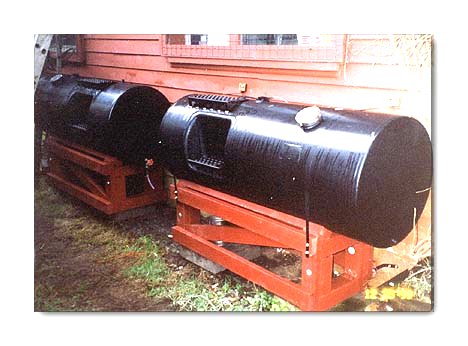
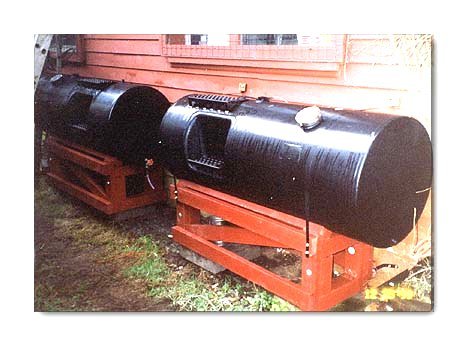
propaganda. "LIQUID PARAFFIN" LAMP OIL Perhaps one of the biggest jokes in the world is "Liquid Paraffin Lamp Oil," priced at about $20.00 per gallon. As few people these days have any familiarity with the history of lamps, their design, or their fuel, they actually buy "Liquid Paraffin Lamp Oil" to burn in kerosene lamps. The lamps were all basically designed before 1890 to burn coal oil, so they are still called "oil lamps" even though coal oil was replaced by kerosene well over 100 years ago. But some marketing genius realized that kerosene is called "paraffin" in England, but by that name is a solid waxy substance in the US, so why not call clear kerosene "Liquid Paraffin Lamp Oil" and fleece the unwary? It worked! I purchase gallons of Low Odor Mineral Spirits at a True Value hardware store for $5.89 a gallon. They sell "Liquid Paraffin Lamp Oil" for ten times as much profit, so they have the necessary incentive to fleece the unwary who believe advertising propaganda. WATER IN KEROSENE Water can contaminate kerosene, saturate the cotton bottom portion of heater wicks, and then the stoves do not work correctly. You can remove water by pouring it through a chamois cloth, or with the use of a proper filter. If kerosene is cloudy, that is water contamination. The fuel tank of the heater must be emptied and rinsed thoroughly to eliminate any remaining water. Don't forget the sump under the wick on side-tank radiant heaters! Remember that the capillary action of wicks is virtually destroyed by water...cotton in particular will absorb water, then the lighter kerosene is denied a capillary "path" to the top of the wick. Performance (clean, odor free heat output) is seriously degraded by even a little water in the kerosene. To circumvent that problem, add a half eyedropper full of 91% to 95% alcohol to the tank of fuel before the wick is "burned dry." [But remember you can't "burn dry" cotton wicks such as the Perfection 500!!!] The alcohol will absorb the water and burn it off with the kerosene. The alcohol burns at a higher temperature than kerosene, so red dye kerosene will burn cleaner with alcohol or "Wick Cleaner." If a fiberglass wick is saturated with water, it is best to remove the wick and wash it with alcohol (and air dry) before reinstallation in the appliance. The same alcohol trick can be used to clean the wick if the wick becomes saturated with diesel or oil by mistake [No guarantees, though. The wick may well have to be replaced.]. If you are using red dye kerosene, using an eyedropper of alcohol every tank full (or using wick cleaner) will keep the wick from needing to be burned dry as often. Pure alcohol is not that hard to find...it's in almost every hardware store, sold as Shellac Thinner. It's wood alcohol, so don't let anyone drink it or they will go blind! Denatured alcohol works, as does 91% alcohol sold in pharmacy stores. A standard heating oil filter can usually be put on a kerosene storage tank, but the filter is only for sediment - not water. If an in-line filter is used, a shut off valve should be placed on the tank side of the filter, so if the filter becomes clogged, the valve can be shut and the filter replaced without draining the tank! The fittings for most common oil filters are only 3/8" diameter, and the fuel must flow through felt filter itself, so do not expect a fast flow from gravity flow systems. Even though the flow is slower than an unimpeded 1/2" or 3/4" pipe or hose, the filter does its job and eliminates the grit and sediment that may (nay, does) accumulate in the tank. COMMENT FROM A READER on kerosene tax rebate, Dec. 23, 2009 Hello, COMMENT FROM A READER, March 1, 2008 A few weeks ago, I emailed you about a problem I was having with my heater. You concluded that there could be water in the sump, and you gave me instructions on how to deal with it. I want to thank you for your help. You were 100% correct. I pulled about 3 ounces of water from the sump. I have a Toyostove DR-86. It isn't hard to get at the sump. I took the whole stove apart and cleaned everything, and then I did the alcohol treatment. After that, I dissassembled everything and just put the stove parts on my bench for a week and allowed everything to dry out. I assembled the stove today, and it works great. Excellent flame and no sputtering or odor. Thank you. Phil F., Pa. INSTALLING AN OLD OIL TANK FOR KEROSENE STORAGE Standard oil tanks are oval and hold 220 gallons. The fitting on the front bottom is for 3/8" threaded pipe. The felt filters for sludge and some water are also 3/8" pipe thread, so it is relatively easy to attach them and have filtered fuel (Many hardware stores sell fuel oil filter units for about $20). To make filling kerosene containers easier, a 3/8" to " adaptor is placed on a 3/8" pipe leading to the edge of the tank, so a boiler valve with 3/4" garden hose threads on the outlet can be used. Then a short length of clear " hose can be made and attached to the boiler valve, and bottles or other containers filled directly without spilling. There are fittings on the bottom corners of the tanks that take 1 1/4" pipe for legs, but they are relatively fragile. The tank can be sat on the legs, but it can't be rocked upright on them, so it must be carefully lifted, and that means two strong men. I had only me, so I used pulleys, levers, winches, etc, to carefully lift and move the tank over the holes I dug for the legs...and still it was hard. I used 2 foot long pipe legs. The fittings are 2 inches above the bottom of the tank. I dug 6 inch deep trenches for each set of legs, put a 1 inch piece of concrete in the holes for the legs to stand on, and then took 1 gallon tin cans with both ends cut out, slid them up over each leg, taped them up in place, then lowered the tank into the trenches. Then I leveled the tank so the legs were solidly on the bottom (but level with a " drop toward the outlet end), filled the trenches with concrete, then worked the gallon cans down about an inch into the concrete and filled the cans with concrete too. That made the legs very strong, anchored securely, and with the concrete extending up the pipe legs for about 8 inches, even the pipe legs are strengthened. The outlet valve is about 16" above ground level, so filling small containers is easy. Most oil tanks are installed lower than that for gravity feeding into a basement. I installed mine high enough to fill a tall bottle with kerosene right from the tap I put on after the filter. I cleaned the inside of the tank by using a pressure sprayer and diesel, spraying through the bungs on top of the tank, and draining it out by removing the bung at the bottom, right behind the 3/8" outlet on the end. What little diesel remained is not enough to contaminate 220 gallons of kero. Then I had the local oil company come out and deliver me 220 gallons of #1 Kerosene stove oil, not furnace oil or #1 diesel, and it had the red dye, of course. It works perfectly. I use it in all of my kerosene heaters, and it burns perfectly. USING OTHER OLD TANKS FOR KEROSENE STORAGE It is sometimes possible to find other old tanks which are perfectly useable for kerosene storage. They may be of an odd shape, but they can be used with a little ingenuity. I found two old Mack truck saddle tanks, each holding 110 gallons. They made fine storage tanks after some modifications and building cradles to hold them. To get the kero out, I removed the 3/4" drain plug at the bottom of one end and replaced the plug with a boiler valve, then made up a short hose from clear 1/2" tubing and a garden hose female replacement end, and that makes filling bottles or jugs very easy indeed (see below, barely visible on end of tank at left).
All of the tanks I use were old, a little rusty, did not leak - and were free. I cleaned the outside of the tanks with rags and solvent, applied a thin film of Ospho to neutralize the rust, let the Ospho dry in the sun for a day, then painted the tanks with an automotive (metal) paint. New tanks cost about $1.00 per gallon...$220 for a 220 gallon tank, and they still need installation. If you have the time and inclination, free tanks are worth the effort and trouble. Pages on this web site:
Information on Kerosene Heaters and Wicks
|
|
|||||||||||||||||||||||||||||||||||||||||||||||||||||||||||||||||||||||||||||||||||||||||||||||