|
A guide to self reliant living |
|||||||||||||||
|
6. Kerosene heaters and cookers 12.
Electrical; generators Miles Stair's
SURVIVAL Miles Stair's
SURVIVAL |
KEROSENE COOKERS or STOVES In an ideal world, everyone would have a kerosene stove. I consider a kerosene kitchen stove to be central to the concept of being self-reliant. Every year the electric power goes out for almost everyone during storms or hurricanes. Without the ability to cook and heat a home, many people evacuate to a motel - and spend more per day than the cost of a kerosene stove! Absurd, but it happens almost every day somewhere in the country. And what about a manufactured event, like the avian flu? Government plans already on the books call for people to be quarantined in their homes. Smart people will want to self-quarantine to avoid unnecessary exposure to pathogens. But what is to stop terrorists from then knocking down an electric transmission tower in a remote area? Given that the electrical grid is tied together, an entire region would lose power. And who would break quarantine to fix that problem? Without a kerosene stove for cooking and a little heat, millions of people could suffer terribly. Many would be forced to go to a shelter, a crowded shelter, and thereby almost ensure they would catch what the least resistant person in the shelter was spreading about. No thanks.
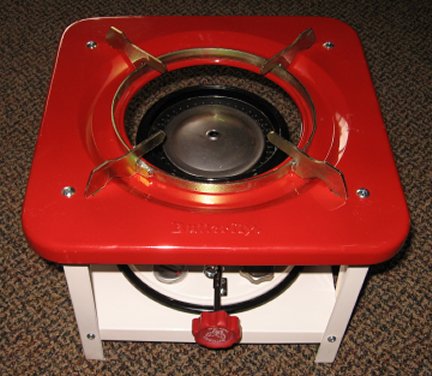
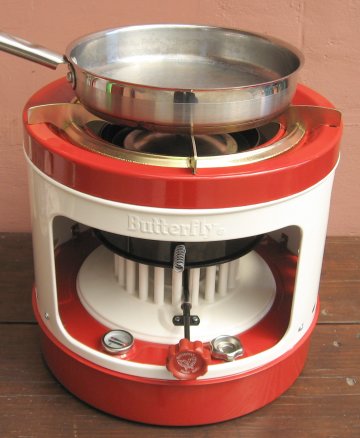
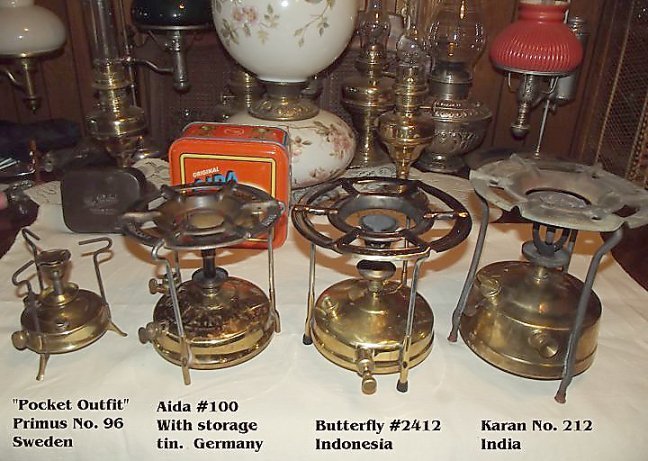
Generally speaking, there are two types of kerosene stoves - the wick type and the the pressure stove. Wick stove can be either multiple small wicks, a single wick standing on its edge (gravity flow Butterfly design), or take a standard heater-type circular wick. I have purchased and used most of them, including with the Korean made Alpaca, the Indonesian made Butterfly (models 2457, 2628, 2413 and 2418), and various pressure stoves such as the Butterfly #2412. At one time I even imported Premier stoves from India to supply the North American market, so I have had a lot of experience with kerosene stoves. WICK STOVES The Butterfly #2413, #2416, #2417 and #2418 models are extremely unique, using a sturdy wick standing on it's edge, with gravity flow from a glass reservoir flowing through a simple cone shaped shut off valve to control the amount of fuel flowing to the wick. These are the same style of stoves in widespread use in rural American before WW II, then called "wickless" stoves. Wicks last years, but you should have spares. The Butterfly multi-strand stoves use what is essentially a cotton mop strand as a wick, the number of wicks being used depending on the heat output. When the top of the wicks becomes cakes with carbon, it is easy to pull them up a little, snip off the top edge with scissors, and you have a brand new burning surface. For more information, see Butterfly #2418 Operating Instructions. WHICH STOVES DO I USE? For the past eight years I have had a #2418 double burner set up on a sun porch, all ready to use when the electricity goes out. I have had a #2457 for many years, as it holds the #2421 Butterfly oven perfectly. That leaves me with two burners on the #2418 for cooking meals, while the single burner #2457 is off to one side, busy baking bread. I gave my mother a #2418 single burner about 8 years ago, and she still has it and uses it whenever the electricity goes out. I gave my daughter-in-law a Butterfly #2628 about seven years ago, and she has used it whenever the electricity is out. I gave them those stoves because they are reliable and will work perfectly even when pulled out of long-term storage during an emergency.
Reviews of all of these stoves are at the links below.
All kerosene cookers and heaters will smoke and smell a little when first lighted, as the burner unit needs to heat up to provide maximum efficient. Just open some windows for a few minutes and the air clears quickly. Likewise, when you turn off the unit, it smells a tad bit, and opened windows solve that problem. DO NOT blow out a kerosene cooker when you are through using it: turn down the wick and let it burn out by itself, which takes a few minutes. The burner unit contains unburned hydrocarbons (kerosene), and if it cools down naturally it burns them up with few fumes. For more information on fuels used in kerosene stoves, read my kerosene fuel primer.
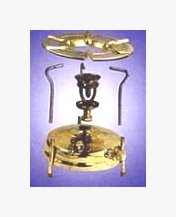
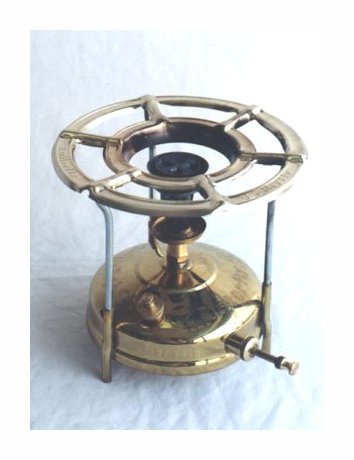
Kerosene pressure stoves such as the Butterfly #2412 share common features with gasoline torches of old -- the generator is preheated by burning alcohol in a cup, then the stove is lit. Unlike the silent operation of a wick type stove, the pressure stoves do produce quite a bit of noise when in use. Except for the pressure pump, pressure stoves have no moving parts, are made of solid brass for years of service, and will burn virtually anything that pours -- but only kerosene or Low Odor Mineral Spirits should be used indoors because they produce almost no carbon monoxide. For emergency use, a kerosene pressure stove has even more advantages. The Butterfly #2412 has the unique advantage of being a "take apart" design - even the fuel tank has a cap which is stored on the pump handle, making the Butterfly #2412 a fantastic stove for emergency use if traveling. I know one fellow who used a Butterfly #2412 on his sail boat for over a decade without any problem...he chose this stove because it would burn any fuel he was likely to encounter anywhere. I keep one stored in my motor home at all times. For daily use, however, I prefer the silent Butterfly wick stoves, but they require absolutely clean, pure 1K kerosene to burn clean. The Butterfly #2412 pressure stove can cleanly burn red dye kerosene and even diesel.
Setting Up A Butterfly Multi-Wick Stove includes instructions that apply only to multi wick stoves such as the Butterfly #2457 and #2628, not the gravity flow Butterfly stoves such as the #2413 and #2418. VERY UNIQUE Special and unique Instruction Manual for 1927 Ward's Windsor Kerosene range, courtesy of New England Gardener. This is a 5.86 MB .pdf download!
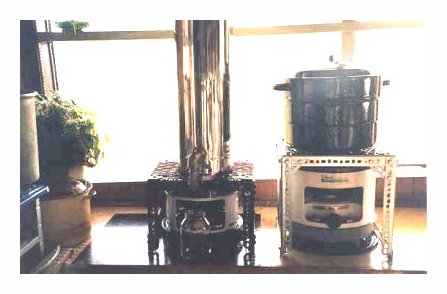
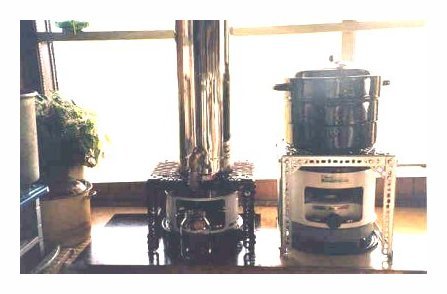
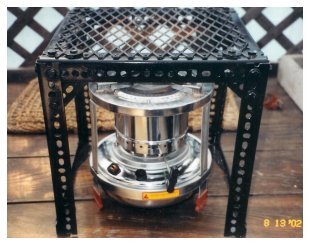
BUILD A SUPPORT STAND FOR YOUR STOVE None of the kerosene stoves are sturdy enough, in my opinion, to support heavy loads like a full pressure cooker or water bath canner. What portable stove by any manufacturer is designed to hold a 16" wide pot weighing over 35 pounds? That large a canner would not even fit on a Coleman gas stove! It is relatively easy to build a cooking stand for a single burner stove to support any size or weight of pot or pan. The double burner Butterfly #2418 is an exception -- it is intended for daily use for years with normal size pots and pans, but is a large stove and quite sturdy when assembled properly. This is really basic, straightforward building, like an erector set from years gone by, and requires few tools. A properly maintained kerosene cooker with a strong support stand to relieve it of any strain should last for decades of constant use.
USING A KEROSENE COOKER AS A HEATER Kerosene cookers can be used as an emergency heat source. I have used the Alpaca, Butterfly, Premier Sr. and Swastik stoves as heaters in my greenhouse on extremely cold winter days. And yes, I have used them in the house for heating as well. The burner unit on a cooker lacks a flame plate on top, as do kerosene heaters: the flame is designed to impact a solid surface directly at the cooking surface. I use an 8" x 8" x 3 5/8" concrete block (or a round steel plate) on top of the units when using them for heating. The flame is adjusted to a bright blue, with no yellow showing, and the concrete block acts as a heat sink, moderating and dissipating the heat. Don't laugh -- it works. The Alpaca needs to be burned at nearly maximum heat output, however, or the fiberglass wick will foul with tar balls and burn poorly. In fact, I've had them literally go out when used for extended periods of time as heaters because of tar ball buildup on the wicks. Then the tar balls need to be crunched with a pair of smooth, paddle bladed pliers just so the wick can retract! I don't like the Alpaca.... With a multi-wick stove like the Butterfly, you can simply snip off the top of the wicks, pull them up a little, and have a fresh surface to burn. You don't do that with an expensive Alpaca wick!
It would be a mistake to think that any kerosene stove can equal the efficiency of a "pure" kerosene heater for heating, as they cannot do so, period. But they do provide heat and can be used for that purpose in an emergency. Let us assume that the electric power is out, it is winter, and you do not want to attract attention to yourself by using a wood stove and putting up smoke signals, and you have a kerosene cooker. At a maximum of 8,500 BTU output, the cooker is not going to heat an entire home, but it will heat a large room well enough to keep it comfortable. I would not recommend sleeping with a cooker going simply because they are not as safe and efficient as a heater, but if the choice is freezing to death, well....be very careful, have the stove well away from any bedding, curtains or combustible materials, on a firm base (not sitting on a rug), etc. There is, in fact, a safer way to use a kerosene cook stove as a heater, and that involved the use of a drip pan or spill tray under the stove. All kerosene heaters have a drip pan, so it only makes sense to extend that safety factor to kerosene stoves. Blitz makes an 11 inch wide galvanized metal "Pet Food Tray" with a 2" raised lip which is perfect for use under a kerosene stove. Wal Mart sells them for less than $4.00, which is very inexpensive insurance. As with any appliance that uses oxygen in the process of combustion, be sure to have several windows cracked an inch or so to provide adequate ventilation.
Related subjects: Kerosene heaters:
Kerosene Stoves, Lanterns and Ovens:
Kerosene, The Fuel, and Storage Tanks |
Butterfly 828
Butterfly #2412
|
|||||||||||||