|
A guide to self reliant living |
||||||||||||||||||||||||||||||
|
6. Kerosene heaters and cookers
12.
Electrical; generators
Miles Stair's SURVIVAL
Miles Stair's
SURVIVAL
|
Garden Tractor Gardening, Part 1 (Wheel Horse) by New England Gardener Part 1 The development of garden tractors really started about the same time as farm tractors, in the 1910's and 1920's. Many of the pre-WWII tractors were large and heavy.
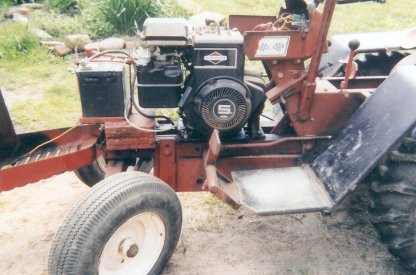
There were over 200 different US companies making two wheel tractors, but many companies sold only to a few neighboring states. After WWII, and into the 1950's, the two wheel tractor reached its peak in development, sales, and popularity. Four wheel garden tractors were taking over, and I believe the designs reached their peak as practical Garden tractors in the 1960's. Some of them stayed in production well after that. The Garden tractor was becoming a big, wide lawn mower. Two different types of Tractors emerged, a light duty lawn tractor, only good for mowing lawns, and a big heavy duty tractor, too wide and to low to the ground to use in an established garden. Part 2 What should we look for in a Garden Tractor? The good news for us is that many of the most practical garden tractors were considered obsolete, and have years of work left in them. Often a real Garden tractor was purchased, and only used to mow the lawn. That is very light work for a frame and transmission intended to pull a moldboard plow through the ground. One of these tractors with a worn out engine or mowing deck, sells for very little. The simple 2 wheel tractors that went out of style can work with even less fuel. The engines on either of these types are literally antiques, and parts and service can be very hard to find.
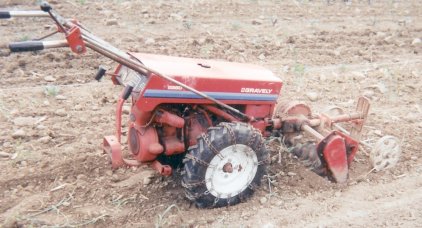
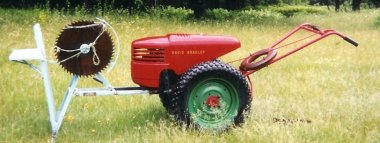
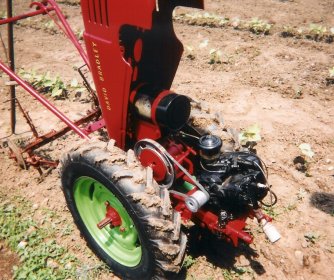
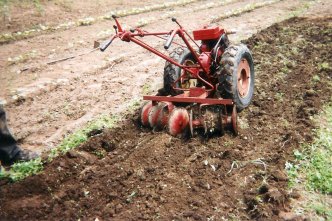
I love my big Gravely riders and walk behinds. Cub Cadet, Power King, Simplicity, Bolens and John Deere and others made powerful tractors with complicated drive trains, and big engines. They have too many critical parts and use too much gas for survival gardening. Make sure the MODEL is a real garden tractor, not a lawn tractor designed only for mowing grass. Most manufacturers made both types. Stay away from automatic drive, the early ones weren't very efficient, and all of them are complicated. Look for a brand that is popular in your area, so you can pick up a few spares that will take the same attachments. Avoid orphan brands of tractors, but don't expect today's dealers to have many parts for tractors this old on the shelf. I will be explaining how using implements pulled through the soil, rather than engine powered rotary tillers, you can grow plenty of food for a large family with only a few gallons of gas a year, or even less. Two or three horsepower is enough for a two wheel tractor, and twice that is fine for a small rider. Now I realize such tractors won't power a big mowing deck, rotary tiller, or snow blower, but they are working fine in my heavy clay soil, with many rocks in it. I live in the last town in my state to be settled, because the soil is so hard to farm. The saying goes, in tractors there are three things that are important, CONDITION, CONDITION, and CONDITION! If you find a well maintained tractor with all the gardening attachments, at a good price, buy it. Just keep these things in mind. Simplicity and Midland made most of the two wheel tractors Wards sold, as well as selling them under their own name. Although there are an incredible number of tractor models, most of the attachments fit all of them. Sears sold the David Bradley two wheel tractors for many years. They have taller tires giving better crop clearance and traction, but have a dry clutch built into the pulley on the gearbox. Now that they are old, they have a nasty habit of sticking in the engaged position, but it wouldn't be hard to convert them to an idler pulley, or at least add a kill switch on the handle bar. Sears also sold many rider Garden Tractors with the simple idler pulley clutch. They made their own attachments to go with either 2 or 4 wheel tractors. You will need to find them for your tractor. All the early brands made and sold their own attachments, but later on the Sleeve Hitch became the standard. It's very much like the hitch on the two wheel tractors Wards sold. Wheel Horse first used a "Slot Hitch" on their riders, but later made a "Clevis Hitch" which is interchangeable onto their earlier tractors, and takes standard Sleeve hitch attachments still made today by Brinley and Agri-fab. Larger garden tractors offered a Category O three point hitch. Sears offered a tiny 3 point hitch for their riders, but that's not the same. Once you have a liftable rear hitch on a rider, the frame for cultivating tines can be made up by buying the steel cut to length, and drilling and bolting it together, or having it welded. Of course it's much easier if you can find it already made. You only need raise the handle bars on a two wheel tractor. I am trying to give you an overview, but I hope you find your tractor WITH its garden attachments. Part 3 Which attachments will I need? In the springtime, I start off disk harrowing my garden every 10-15 days, to keep the weeds from getting established.
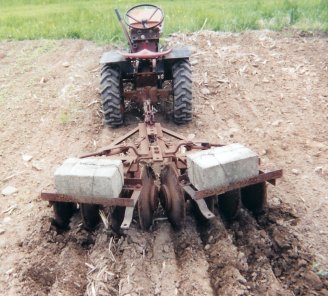
Two of the ATV types made now can be flipped over, on to transport wheels. All types will have places to add weight, usually cement blocks. You want to add enough to keep the disks cutting into soft ground a couple inches, or more weight if you are cutting in a cover crop or plant debris from last year. With a two wheel tractor, you can do this work with a smaller disk harrow, but it will take a lot more passes. With a rider you can also buy several garden tractor size disk harrows, and pull them one behind the other. This style of disk harrow will stay in contact with the ground. You won't be able to back up, so start turning soon enough to change direction inside the garden itself. Vary your path through the garden, going say east to west on one pass, and north to south next time. When the right time comes, you are ready to broadcast seed for wheat, oats, buckwheat, rye, or any small grain, then cover it lightly with the same disk harrow, and wait for harvest. For row crops you need a furrow to plant in, with loosened soil well below the seeds, as well as on top.
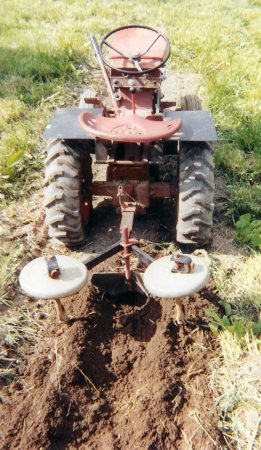
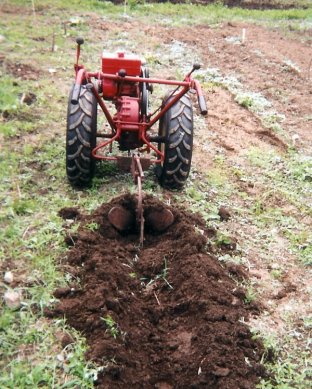
For large seeds like corn or beans, and even potatoes, onions, or flower bulbs, this can be done with a V shaped furrowing plow set deep, with a pair of tines on either side to partly back fill the furrow.[#B-9] The furrower needs to be a small one, less than 6 inches wide. If you can't find one that narrow, you may have to use something similar. Farm supply stores will have huge selections of tools, but many will be sized for farm tractors.
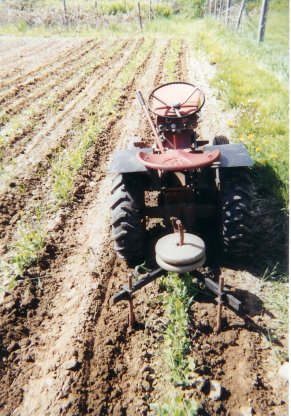
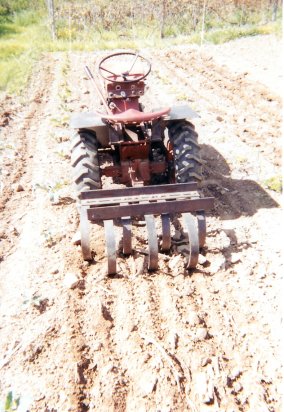
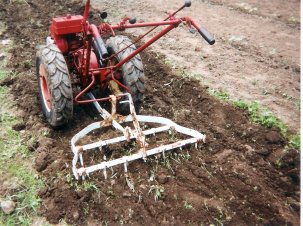
For small seeds like carrots, spinach and beets, I simply use a single tine in the center, set deep, to loosen the soil well below the seed. After dropping in tiny seed, it's easier to just cover it with a hoe. As long as your tractor can clear the crops, you can drive your two or four wheel tractor over the rows, to cultivate them. For the paths between the rows, you want many tines set shallow, and there are many styles to do this. I am glad I have several types, but I can't say one is always best. The fixed tines like I described before work well, but if you hit a rock, they all come up of the ground to ride over it. You can attach the furrower and also hillers for hilling corn or potatoes though.
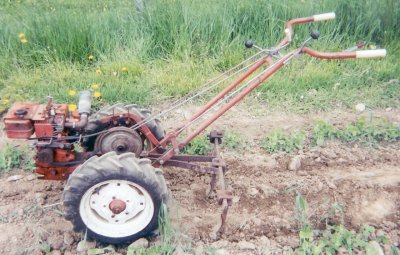
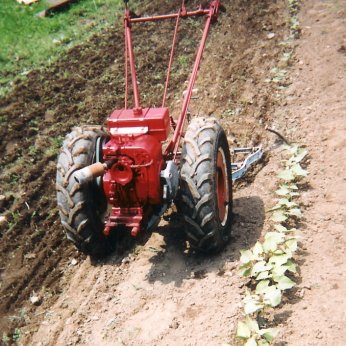
Here in Southern New England, and up in the hills where it's cooler, I only mulch Cole crops which like cool soil. If you have dry hot summers, you will mulch earlier, and end your tractor cultivating. I broadcast rye into the corn with the last cultivation. I seldom use my moldboard plows or rototillers any more. A 2 wheel Sears David Bradley with a 1&3/4 hp engine or my 5 hp Wheel Horse rider will pull a 6&1/2 wide plow in garden soil. With bigger engines, you could pull bigger plows, but you don't need to. To open new ground, I cover it with a thick black plastic Silage cover in the fall or early spring, and weigh down all the edges. I guess the poly tarps would work, but I'd try the ones that block the sunlight. Pull it up a week or so before planting time and disk it heavy. A small light 2 wheel tractor like this 1958 Simplicity Model LC will cultivate your garden paths, which you should do every 5-10 days. Your soil would have to be looser than mine to dig deeply under the furrows though. A larger model Simplicity, Midland, or David Bradley could do that work, or any small rider. These little Garden Tractors will do in an hour what hand tools would take weeks to accomplish, allowing you to grow far more food. - Framerik Part 4 Garden Tractor Versatility [Click here for a Simplicity Model "C" Original Brochure in .pfd format] GARDENING ARTICLES by New England Gardener -
Those interested in learning more about walk behind tractors can join an e-mail Yahoo Group devoted to this endeavor, moderated by New England Gardener, the author of this article. See http://groups.yahoo.com/group/simplicity_walking_tractors/
Continued at Garden Tractor Gardening, Part II GARDENING ARTICLES by New England Gardener
| 1. Food
| 2. Manna Meals |
3. Water |
4. Sanitation
| 5. Medical,
health |
| 6. Kerosene heaters and cookers | 7. Lighting | 8. Wood cooking and heating | | 9. Communications | 10. Essential Tools | 11. Home built items | | 12. Electrical; generators and power | 13. War preparedness | 14. Gardening | |
|
||||||||||||||||||||||||||||