|
A guide to self reliant living |
||||||||||
|
6. Kerosene heaters and cookers
12.
Electrical; generators
Miles Stair's
SURVIVAL
Miles Stair's
SURVIVAL |
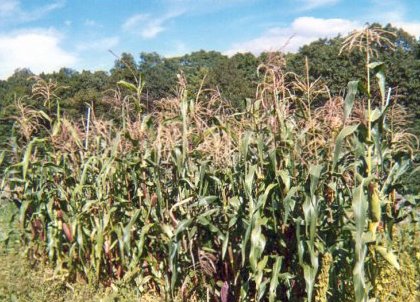
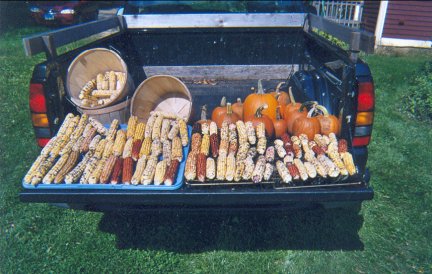
CORN IS KING FOR YOUR TABLE AND YOUR LIVESTOCK by New England Gardener Part 1 - Selecting the type to grow Anywhere field corn can be grown; it is usually the most important crop. Farmers love it for animal feed. Let's take a close look at home production for grain. There are four general types of corn, the vegetable sweet corn, pop corn, flint corn and dent corn. To grind for flour, flint is considered the best, but the yield is low for commercial production, and it's hard to find seed for. I have grown heirloom flint corn, but I didn't continue to do so because of the lower yields. Dent corn is the usual choice, but any kind can be grown to full maturity, and dried. There are both white and yellow kernel varieties; in general the white will have more fiber and the yellow more vitamins. So called Indian corn comes in other colors too. Some of these are the traditional heirloom varieties Native Americans developed for their own climate, and others have been bred as decorations, not for food. Field corn may cross breed with late Sweet [vegetable] corn. The Flint and Indian varieties are more likely to do so. That would result in the ears of your sweet corn being tough and starchy, rather than sweet. Any seed saved would be a cross or Hybrid, not the same as either parent. The usual advice to prevent cross pollination in Sweet Corn is to plant varieties that mature10 days to two weeks apart. The meaning of the word "Mature", in Sweet Corn is the succulent "green" stage, and "Mature" for field corn is dry, so you can't figure when pollination occurs from the number of days shown in a catalog. The Flint and Indian corn varieties I have grown here pollinated at about the same time as Silver Queen and late Heirloom Sweet Corn. The Dent corn I have grown was later, but it might be a problem for you. If you grow both Sweet and Field Corn, stick to early varieties of Sweet Corn. To determine if you can grow a later Sweet Corn, mark on your calendar when the tops of each kind tassel out.[ That is when the vertical spike at the top of the plant opens to have side shoots ]. You need ten days between these dates. Pollination is needed for each kernel to form. Plant corn in blocks of four or more rows, is the usual recommendation, but I can get by with less than four rows, especially if it's planted in hills. For saving pure seed, distances of 1/4 mile or more are needed between varieties that may pollinate at the same time. [Note from Miles. Corn is "open pollinated," or pollinated by the wind...honeybees are not needed. For that reason, the distance of 1/4 mile separation for different varieties of corn to be saved as pure stock for seed is quite critical. For more information on pollination, read my article by clicking here.] The amount of protein in dry corn is usually 7 to 8%, similar to wheat, rye and rice. The Krugs dent field corn I have been growing for the past few years is 10% protein, which is why I was eager to breed a local strain of it here on my farm. Part 2 - Growing the corn I fertilize heavily with aged chicken manure, or you could use 10-10-10. Put it directly under where the seed will go, but deeper, so it doesn't touch. The soil must be warmed well by the sun. A common expression around here is, "don't plant your corn until the oak leaves are as big as a mouse's ear", but that may be a little too early. If working the soil with hand tools, usually corn is grown in hills with about 5 seeds arranged in an 8 inch circle. With a Garden Tractor, furrows are made, and the seed is set about 4 inches apart. Either way is fine, but hills are more resistant to being blown over by the wind. I have heavy, but fertile soil here. If you are short of seed, or have sandy weak ground, you may want to plant it farther apart. Cover the seed with 1-2 inches of soil. Enough so the birds can't easily find it. If a heavy rain comes shortly after planting, the dry seed may 'float' up to the surface. This can be prevented by soaking the seed overnight, which will also give them a head start at germinating if it's dry. Corn likes a lot of cultivation to loosen and aerate the soil. Deeply dig the soil 4 or 5 inches to the sides of the plants, so the roots have an easy place to spread into. As it grows, keep moving a little farther away until the corn is knee high. Now it's time to hill the corn, [ mound loose soil against the plants from the sides ]. With a Garden Tractor, I broadcast winter rye over the standing corn just before hilling it. Rye gives off something in its roots that weeds do not like. I don't bother to cut each corn stalk, and let the winter rye mature the next summer, but if food was scarce, I would. Corn loves hot humid weather and lots of rainfall through the summer. If corn borers may be a problem, when silk first appears on the ears, brush or spray mineral oil into it. This will coat the skin of the borer worms, and kill them, as they try to get to the kernels inside. It will not need any other attention. Dent corn gets its name from the kernels "denting" in at the tips when it's mature.
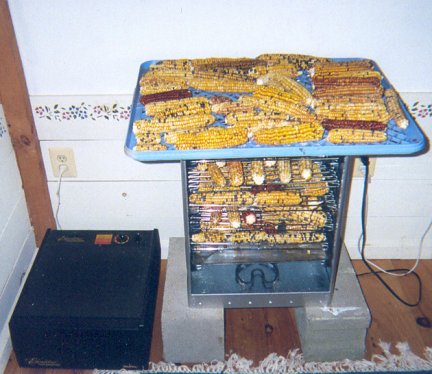
Part - 3 Harvesting and drying corn for the table If you have very clear weather in the fall, you may be able to just let it dry on the stalk; otherwise you will get some mold in it. Cows don't mind a little mold, but I don't want any in my food. Leave it on the cob. You may be able to store it in a corn crib. This is a very well ventilated shed, with a good roof in a sunny, breezy spot. You should mouse proof all around the corn with two layers of hardware cloth spaced about an inch apart. [heavy mesh, like a screen, but welded, not just woven]. It should be elevated on legs rodents can't climb, and high enough so they can't jump up onto it, and the air moves freely under it. The topsoil should be removed from under and around the crib, and replaced with stone for drainage. Some farmers use a fan with duct work to help dry there crop. A solar corn crib could be made, but for just a few bushels, your home food dehydrator, or kitchen Range oven set very low will work.
This year I will be trying something new. I have purchased an electric smoker like hunters might use, and plan to dry my corn in that. For long term use, I will be working on converting it to solar power. Select the biggest, well filled ears, and keep them separate for seed next year. Make sure these ears don't get over heated while drying. The cob helps wick away moisture. The kernels will come off if you wring the ear with your hands, twisting in opposite directions. Lehman's Hardware offers a cast aluminum 'ring' that fits over the ear, giving you better leverage and saving your hands. I have one of those, and use it if I am shelling 1/2 bushel or more.
I spread out the kernels on a screen to check them over and remove any foreign material. Store them in rodent proof containers. Once dry, you can let them freeze in the barn. If you will be keeping them inside the house, or you live in a warm climate, it's good to put them in a freezer for at least four days. When you take the container out, insulate it to prevent condensation forming on it. You can put it in a picnic cooler, or wrap it with blankets.
Don't grind the corn, or any other grain, until just before you use it. You might be able to use a stone mill for Flint corn, but the cheaper, simpler mill with steel burs is needed for Dent corn.
Part 4 - Corn for livestock feed All livestock seem to love the dry corn like we would eat, but they don't need it ground into flour. You should be able to adjust most steel bur hand mills to crack the kernels into several pieces. Hand crank corn shellers are also available from Lehmans, and Antique shops may have the old fashion type that looks like an enclosed saw horse, with a big flywheel on the side. Most animals also love the ears freshly picked green [like sweet corn], or dried ears that have been thoroughly soaked under water for a day. They will get every single kernel off them. This saves you a lot of work. Pigs and chickens will readily eat rotten and moldy food we couldn't, but I try to keep it reasonably clean. To grow or lay eggs, they need a diet that averages 16% protein, and corn averages 8%. You will need to supplement with waste milk from dairy animals, or crops like sunflower seed, flax seed, amaranth seed or beans. Sheep and goats will eat the leaves and the tops off the corn stalks, and cattle can eat most all of the plant when it is still green. They have to be really hungry to eat dry corn stalks. Over the winter, they need hay AND 16% protein grain OR silage instead. These three animals are grazers, and they can convert plant fiber into protein. With a hammer mill or chipper shredder, the whole dry corn on the cob can be ground and fed dry like grain. This is called coble. This is still only around 7% protein, so it needs to be supplemented too. The whole plant can be chopped while still green, and made into silage. The ground material must be tightly packed to get the air out of it, and sealed. It will gradually ferment, similar to sauerkraut. Once opened to the air again, it will spoil in a couple days, but it does keep longer in the winter. The silo or bunker has to be the right size so you feed off the 'top', or end before that happens. I have made silage in large leaf bags and plastic trash cans for a few goats, but it takes a lot or fussing. It's not practical, but growing high protein crops to supplement the common grains isn't so easy either. Now most everyone buys feeds mixed with high protein supplements at a grain mill. Throwing green ears of corn directly to pigs and chickens is the simplest way to use it. Other small grains can be sprouted, but corn kernels that have damage will spoil. Chickens won't mind though. - New England Gardener
|
1. Food | 2.
Manna Meals | 3. Water |
4. Sanitation | 5. Medical, health |
| 6. Kerosene heaters and cookers | 7. Lighting | 8. Wood cooking and heating | | 9. Communications | 10. Essential Tools | 11. Home built items | | 12. Electrical; generators and power | 13. War preparedness | 14. Gardening |
| HOME |
PROPHECY
| PREPARATIONS
| QUICKENING
NEWS | COMMENTARY
BY MILES |
| GUEST SUBMISSIONS | BOOKLETS BY MILES | CONTACT INFORMATION | | LINKS | RADIATION INDEX & JET STREAM | DEVOTIONAL ITEMS | | PHOTO INDEX | LIBRARY | SURVIVAL SHOP |
|
||||||||