|
A guide to self reliant living |
|||||||||||||||
|
6. Kerosene heaters and cookers
12.
Electrical; generators
Miles Stair's
SURVIVAL Miles Stair's
SURVIVAL |
CHOOSING GARDENING TOOLS by New England Gardener For working your vegetable garden and
field crops you will need good quality tools, designed
for each task. Growing up with power tools that can be
adapted to various jobs, we sometimes don't realize how
big a difference it makes to have the right tool. It also
needs to be of the correct weight and size, to do the job
efficiently. If you are not certain which one to choose,
bring several, and see which one is easier to work
with.
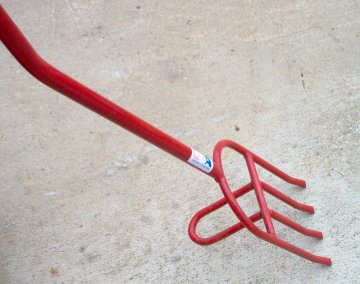
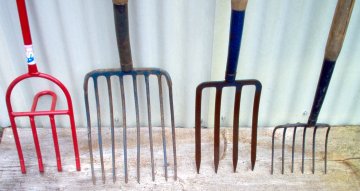
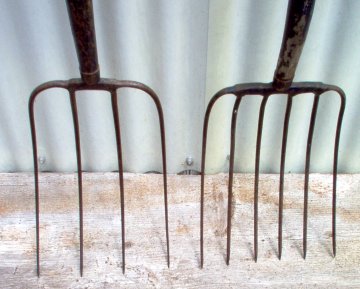
For Raised Bed Gardening, a wide digging fork with two handles is available. It allows you to use both feet to push it into the ground, and both arms to turn the soil. Everyone needs both a shovel and a digging fork. [Note from Miles Stair: The digging fork shown above left has a wide "T" handle for leverage and a brace to push it into the ground. When pulling back to pry out the section of dirt or sod, the brace acts as a lever, easing the work of digging in heavy soils. This is the fork I use in our Oregon Coastal clay soil.]. I use a post hole digger to make holes and work the soil under them when I plant hills of squash or corn, or set out plants.
The hoe most commonly seen today is for very light, shallow cultivation, and is also called an onion hoe. You pass the thin sharp blade along just under the surface to cut off the roots of the weeds, and there are other styles now too. For making furrows to plant in, I like what is called a Warren hoe, which is pointed. It also works very well hoeing up the sides of hills and raised beds. You need stout field or grape hoes in several widths and weights. These chop heavier soil and plant debris.
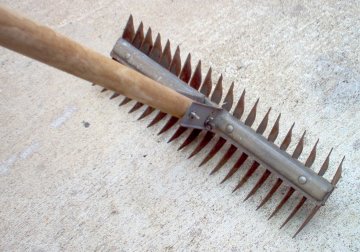
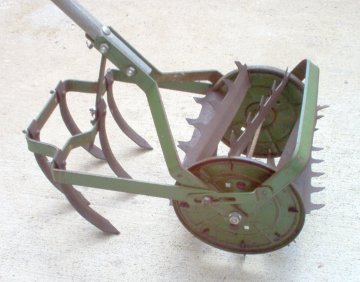
The common steel garden rake is for fine seed beds, but you will want a larger, heavier, and stronger version with longer teeth spaced farther apart, for raking off old vines and stalks or moving more soil. For cultivating a little farther from the plant, something with 2 or 3 "C" shaped tines that go deeply into the soil NEXT to the roots, will aerate the soil and make the crops grow. This should be done every 5 to 10 days until the soil is warm enough to mulch, or you plant a cover crop. When people rototill, they tend to work all of the soil into a fine seed bed, when what you want to do is just work the areas the crop needs. With large seeds like beans or corn, or any plant you set out, you don't need any fine seed bed at all. If working your soil raises a cloud of dust, its too dry; if you squeeze a handful and it forms a lump that doesn't break easily its to wet.
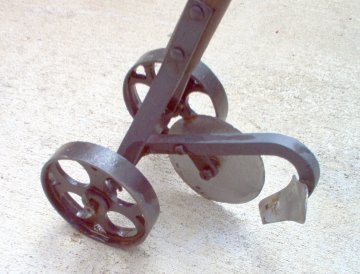
To grow food with hand tools you need to keep the garden soil free of weeds year around. Don't let it get ahead of you. The next step up to save time and work is a Wheel Hoe. It's powered by you pushing it, and you can attach a variety of very small tools for different garden tasks. I tried pulling it like a mule would, and letting my wife steer it, and that is a lot easier, but it only works with long rows, because the harness has to be long or I'd just pull the wheel hoe up out of the ground. LEHMAN'S HARDWARE has most of these tools in one catalog.
|
|
|||||||||||||