|
|
|||||||||||||||||||||||||
|
6. Kerosene heaters and cookers 12.
Electrical; generators Miles Stair's SURVIVAL Miles Stair's SURVIVAL
|
EMP Commission Warns Of Year-Long Blackout And A Massive Death Toll
A federal EMP commission report warns that even the
smallest EMP attack on our grid system would down it for about a year,
if not longer. A year-long blackout would certainly be coupled with a
massive death toll that would devastate entire populations. “The United States — and modern civilization more
generally — faces a present and continuing existential threat from
naturally occurring and man-made electromagnetic pulse assault and
related attacks on military and critical national infrastructures. A
nationwide blackout of the electric power grid and grid-dependent
critical infrastructures — communications, transportation, sanitation,
food and water supply — could plausibly last a year or longer. Many of
the systems designed to provide renewable, stand-alone power in case
of an emergency, such as generators, uninterruptible power supplies,
and renewable energy grid components, are also vulnerable to EMP
attack,” said the 27-page report. Three reports on the issue of an EMP attack have been
declassified by the Pentagon and seven more are awaiting clearance.
Among those declassified documents, was a report from Peter Vincent Pry,
who served on a prior EMP Commission and is executive director of the
Task Force on National and Homeland Security, spelling out the human
toll of an EMP attack on the electric grid. He also advises the current
commission.
Read the entire EMP Commission report by following the link below:
=======
The "Most Significant Danger" According To Elliott's Paul Singer ~~~~ PRACTICAL PROTECTION ~~~~ Many people have read the book "One Second After" by William R. Forstchen and believe that would be the scenario after a sneak EMP attack. Actually, such an attack is quite possible. North Korea has enhanced-EMP nukes. Iran is developing nuclear weapons and could well have one or two now. And both the Norks and Iran have launched satellites, so they do have the missiles to deliver those nukes. Iran has also launched SCUD missiles from "rust bucket" freighters and has shown they could deliver an EMP attack from off-shore without even using an ICBM. The attack itself as described in "One Second After" is therefore quite plausible. It is the rest of the book that is completely unbelievable. Let us look at the actual story line of the book to see how the author not only knew nothing about survival but had no imagination or knowledge of country living at all - and Forstchen is supposedly a real life professor of history! The hero, Professor (Col.) John Matherson, supposedly taught asymmetrical warfare before he retired from the military, yet knew absolutely nothing about how to survive asymmetrical warfare! One dominant theme in One Second After is that the main character’s daughter was a Type 1 diabetic. Her medication needed to be refrigerated in order to maintain potency. Right to the end of the book not a single person in Black Mountain or Swannanoa had a working refrigerator. The combined towns had nine doctors and not one of them had refrigeration for any of their medications. The combined population of both towns was given as about 10,000 people...and not one of them had a motor home or travel trailer, if we are to believe the story line in the book. RV’s have propane refrigerators, and just barely more than a pilot light is needed to run an absorption refrigerator in an RV. A couple of RV refrigerators could have kept badly-needed medications for the whole town from losing their potency. There are small refrigerators which run on 12 volt electricity. It was never mentioned in the book, but there had to be an auto parts store in one of those towns. An automotive alternator in a box, not hooked up to anything, stored on metal shelving in a building with a metal roof, would not be fried by EMP. Auto parts stores have pulley blocks and V-belts. Other stores or individuals would have an exercycle like a Schwinn Air-Dyne. It would take less than a day to hook up an exercycle to an automotive alternator and be able to generate enough 12 volt electricity to charge an automotive battery and run a small refrigerator without too much exertion. It never happened. One with think that at least one person in the two towns of Black Mountain and Swannanoa would have had an old short wave radio such as a Zenith TransOceanic. Or a small modern transistor SW radio stored in a Faraday cage. An exercycle powering an alternator can charge a 12 volt battery for powering radios. An inverter to convert 12 v to 110 v, not connected to any appliances, would most likely not be fried by an EMP pulse, certainly not damaged if stored in a Faraday cage, and could power a shortwave radio to hear news from undamaged parts of the world. Never happened in the book. Nothing creative ever happened in the book! Their world died with the EMP blast and they could not create even a semblance of a new world with what they had left to use. Look at the food situation in Black Mountain. Rationing went into effect within days - 1200 calories a day for a month, then it was dropped to 900 calories a day for another month, until the final battle with The Posse cannibals at the end of the second month. In the book, 900 died of starvation in the first month and in six weeks 2,000 were dead, children had bloated stomachs, etc. Almost all modern diets are 1200 calories for women, 1500 calories a day for men, for the five or six weeks of a normal diet. On those physician-approved diets, people lose weight, which is the point of a diet, but they go to work and carry on a normal existence - they don’t drop dead of starvation in a month! It was the food situation in One Second After that really shows the abysmal ignorance of the author, Forstchen. Remember the timing - the EMP attack took place on a fine spring day. Many greens planted in spring will be ready to eat in less than two months. Meat was only cooked in a barbecue and had to be eaten in a "gorge feast" as it absolutely could not be preserved or saved at all - it had to be consumed virtually immediately. That means: 1. No one had a meat grinder and knew how to make Hamburger Rocks. 2. No one had a smoke house. 3. No one had a kerosene or wood cook stove. 4. No one knew how to make jerky. 5. No one knew how to can meat. 6. Even after six weeks of "starvation" some meat sources like bear were considered unpalatable because the meat was greasy. In fact, fat is absolutely vital in a diet and those working hard on minimal caloric intake actually crave fat! Same for other food sources: 1. No one had a grain grinder. 2. No one had a greenhouse or could build cold frames. 3. No one had a winter garden. 4. No one ever learned how to dry, can or preserve produce. 5. No one in the two towns had a gasoline powered rototiller or garden tiller so gardens could be planted. Older small gasoline engines have magneto ignitions and would not be fried by EMP. 6. By planting quickly, lettuce, peas and other fast growing greens could have been ready for consumption by the middle of the second month! 7. Even by the end of summer no one knew how to dry or can squash, corn, berries and other produce so food would be available in the winter. 8. Even by the end of the book, over a year after the EMP attack, not a single person in the two towns ever identified any wild or cultivated grains, ground them and preserved some flour for bread in the winter, planted a field of grain so there could be bread the following year, saved garden seeds or planted a garden of "fuel foods." The town doctor was worried about cholera or typhus, but did not give a single thought to veterinary medications such as Terramycin TM-25, a virtual specific for both. P. 171-172. Not a single person in the two towns had a kerosene lamp, stove or range. Nor were there any wood ranges in town that could be used for canning, making jerky, using the oven as a dryer, etc. No one could reload ammunition and cast bullets. No one could make a catapult to hurl Molotov Cocktails at The Posse. Nobody in Black Mountain or Swannanoa ever spoke with the "legendary Franklins," the survivalists, to see if they might have some ideas that would help everyone survive. The final idiocy is an hour before the fight with The Posse, Prof Matherson moves his family to Grandma Jen’s house. One hour! They had been planning for weeks how to defeat The Posse and that involved fires alongside the freeway, and those fires would burn up their house! But they waited until the last minute and grabbed what they could for the move to Jen’s house, leaving behind bedding, clothing and other supplies to be burned in the fire. We are to believe that for two months the Matherson family had been using water from the swimming pool. In Jan’s back yard was a bubbling creek! (p. 316). It would have taken at most a day to rig up a gravity flow water system using garden hoses so that toilets would flush, etc. The bubbling creek water would still have had to be sterilized, but would not have been full of algae and have to be carried! Anyone who has read this website knows how to survive far better than anyone in the towns of Black Mountain and Swannanoa, as presented by William R. Forstchen. Of course it is possible that Forstchen wrote the book as a deception, a satire, to illustrate the abysmal ignorance of town leaders and society in general as being capable of taking any type of steps toward self-reliance on their own, remaining hopelessly inept until the calvary/central government rides to the rescue. ~~~~~~~~~~~~~
Iranian Nuke Attack on US Easy as EMP? Nov. 18, 2011 Nuke Over U. S. Could Unleash Electromagnetic (EMP) Tsunami Military Source Warns of North Korea's EMP Bomb Sept. 7, 2009 Surviving EMP to depend on preparation An EMP Attack, Thinking The Unthinkable "Project STARFISH PRIME is probably the most famous test shot in EMP lore because it burned out street lights in Hawaii at a slant range of 800 miles, but it was a high altitude detonation (about 240 miles up). STARFISH was 1.4 Mt; a larger bomb at higher altitude would reach out farther. Conversely, a surface burst also creates an EMP, but the pulse is very quickly attenuated. Depending on the size of the burst, the pulse could be gone in 10-30 miles, depending on the size of the yield. It’s not as much the pulse that’s being attenuated, but the ionizing radiation (which creates the pulse) that’s stopped fairly quickly in the lower atmosphere." Ikstrums, Sept. 2, 2005 A surprise EMP attack could well destroy all exposed electrical equipment, including generators, and leave the country in the dark for decades. The electrical infrastructure would fail, of course, but so would the banking system, virtually all transportation, the pumping of fuel, etc. In short, our country would be reduced to 1870's technology almost instantly. But individuals can prepare now, while there is still time.
"EMP effects go beyond damaging equipment. They also disrupt the
ionosphere severely, which affects RF propagation of several radio bands
for anywhere from one hour to over a day. Projects TEAK and ORANGE (high
altitude, 3.8 Mt each) disrupted a Navy VLF comm link that was 3,000
miles away at the closest point to the blasts.
As most people depend upon city water that must be pumped through electric pumps, a gravity flow water system would be a decided advantage in long term survival. My booklet, "Rainwater Collection and Storage," gives precise information on how to collect and store water for your own family without attracting attention to yourself. Even if you have taken the protective measures given below, the most likely timing of an EMP attack would be before noon on the West Coast, about 3:00 PM on the East Coast, to catch as many vehicles on the highway as possible - and while people are at work, far from their homes. The roads would be clogged with vehicles that no longer worked, families separated, and thus maximum disruption of the economy and fear instilled in the populace. Remember, an EMP attack would be a terrorist's dream, and causing maximum panic in the civilian population would factor highly into the timing of such an event. Therefore, wise people will have an evacuation plan already formulated! So how do we protect our equipment? There is no definitive answer, as the results of testing for EMP has not been released to the general public. An EMP is both an electric field and a perpendicular magnetic field. The electric field is what does the damage and is measured in volts per meter (V/m). We can infer and extrapolate, but there are no guarantees, as an EMP pulse can only last 1/100th of a second but project 50,000 to 100,000 volts per meter (V/m). [Ikstrums, Sept. 2, 2005.] There are two sorts of damage that can occur as a result of an EMP pulse. The first type of damage is that caused directly to exposed transistors, diodes, and circuit boards in radios, transmitters, ignition circuits in vehicles, solar panel controllers, etc. An EMP pulse travels in a straight line, so protection is needed from an EMP from the sides and the top except if the object to be protected is sitting on a conductive surface. The second is through the accumulation of an overload of electricity on a long line, such as a power line.
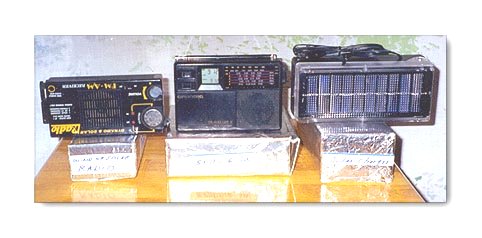
Metal Boxes and Small Metal Buildings Faraday cages can be built to totally enclose sensitive equipment not in use. This subject is covered in more detail at this link for Faraday cages. In general, the equipment is placed in a metal or foil covered box, insulated on the inside, and preferably grounded. Exposed radios and similar equipment are extremely difficult to protect, particularly if they are plugged into a 110 volt household electric circuit. In that case, spare equipment stored in Faraday cages would be most advantageous. If the Faraday cages are sitting on a conductive surface, they should be grounded. Grounding is safer in any case, though. The second problem, long line accumulation of an EMP surge, requires isolation of equipment and proper grounding, so the EMP pulse has an easier path to earth than through the equipment. Ground rods should be driven down to wet earth, if at all possible, to provide a sufficient ground. That may mean an 8 foot ground rod, or even longer, depending upon your location. All the photos below are "thumbnails." Click on the photo to enlarge it, then use the "back" button on your browser to come back to this page.
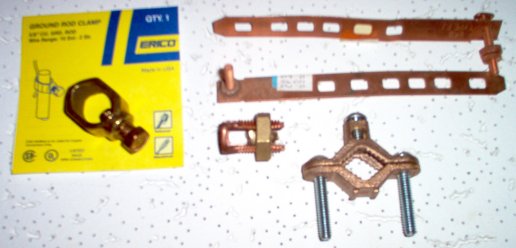
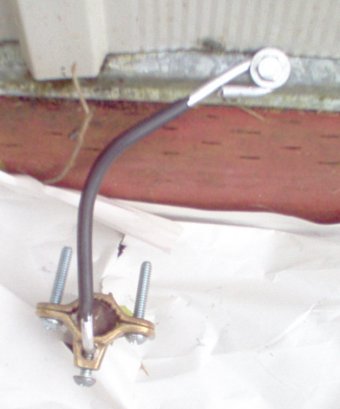
The ground clamps in the photo above cost less than $3.00 each, and are available at almost any hardware store.
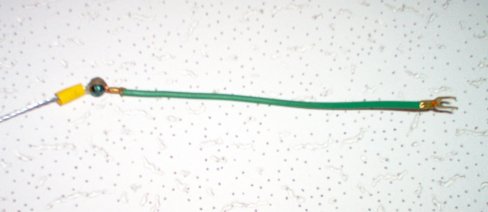
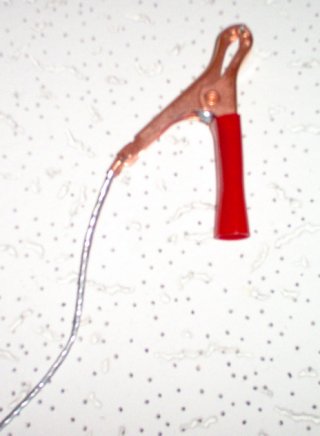
The package of two ground screws above cost me $2.49 at a True Value Hardware store. True Value Hardware part #GCS12SM2.
There are no guarantees that a simple ground screw will completely protect an electric motor plugged into the socket to which the ground screw is attached. Grounding electric motors is hard! But it is a very inexpensive way to help make sure that any electrical surges find an easier path to ground than through an electric motor, and thus a well pump or freezer have a chance of surviving an EMP pulse.
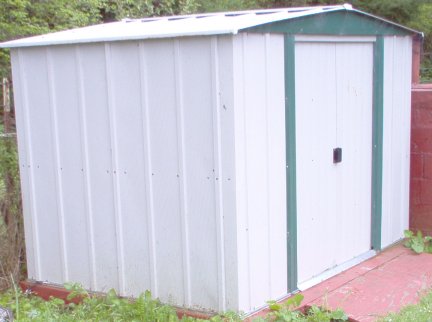
The shed has a wooden floor, which is nonconductive. An EMP pulse hitting the metal shed would be bled off to the ground wire, so items inside should be safe. If items inside a metal shed need to be grounded, the ground wire should be insulated and go to a separate ground rod to prevent feedback! Let me explain "feedback." If two ground wires are attached to the same ground rod, and only one wire, say the one from a metal shed, feeds an EMP pulse to the ground, that same electricity can flow back up (feedback) the ground wire to a grounded generator inside the shed, for example, as the ground wires are effectively joined by the ground rod. If two ground rods cannot be used, it is far better to ground the shed and not ground a generator or ATV on a nonconductive floor in the shed.
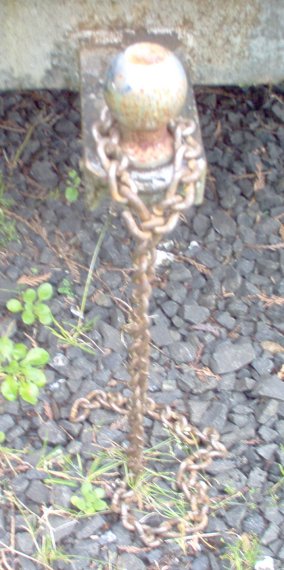
The illustration above is for grounding a vehicle that is not moving. How does one ground a moving vehicle? A dragging chain! The chain above has enough length to wrap around the front of the trailer hitch, just behind the rear axle and about 3 feet in front of the rear bumper, with about 4" of chain left to drag on the ground. It would be very hard for someone to see the dragging chain except on vehicles with lift kits. The chain simply drags along on the pavement, makes very little noise, and wears out relatively slowly. The frame and body of the vehicle are normally insulated from the ground by the rubber tires, but the dragging chain makes a good ground. I use a long enough chain so that I could make 3 loops around the front of the trailer hitch and still have 4" of chain dragging. When the chain wears down, I can remove the attachment clamp, unwrap one loop in the chain, and again have enough chain dragging to make a good ground. So, attach a ground chain and go on vacation without worrying about being stuck. Will a dragging chain actually ground a vehicle? Yes. Until perhaps 40 years ago, many states required gasoline tankers to be grounded via a dragging chain so a buildup of static electricity would not cause a gasoline explosion. Then some bureaucrat realized the dragging chain might cause some idiot to think there was a reason for the chain, and therefore an explosion was possible. So, instead of using chains to eliminate the problem, gasoline tankers were required to have a tiny diamond shaped sign on the back reading "1203." The public was not told that "1203" meant highly volatile gasoline was in the tank as that too might scare them, but the sign was all the "cover" the bureaucrats needed to say they had warned the public. Very clever. Insane, but clever.
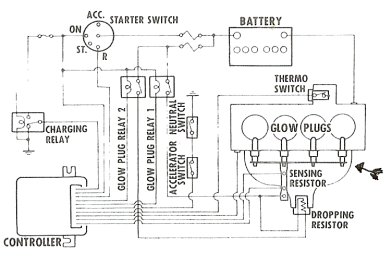
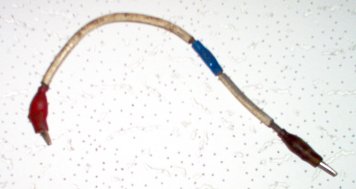
Older diesel engine vehicles are more reliable under EMP conditions because they lack the computerized fuel management and ignition systems of modern gasoline engine vehicles. However, that does not mean that an ungrounded diesel vehicle would still start! It would run, but getting current to the glow plugs might well mean the use of a small, easily made jumper cable. Note on the diagram below the controller, sensing resistor, dropping resistor, thermo switch, relays, etc, all between the battery and the glow plugs. All those susceptible components can be bypassed by using a jumper cable from the positive terminal on the battery to the glow plug buss.
You will want to be pretty quick when using the jumper cable. Each glow plug draws about 12 amps, so a 4 cylinder engine is drawing almost 50 amps through that 10 gauge jumper wire. Once the engine is running, you will want to pull off the jumper cable as fast as you can. As long as the engine is warm, it will start without the use of the jumper cable and glow plugs. The radio and some other electrical devices would not work, but the vehicle would run!
A running vehicle will be rare after an EMP attack, and you won't want yours stolen. Some people know how to "hot wire" the ignition system and may know about the jumper cable system described above. But you can fool them if you want to. Take a look at the fuel injector pump on a diesel engine. You will find a single, small electrical wire attached to the injector pump. Diesel engines will run until the fuel is shut off, so a small electro magnet pulls a shut off plug out of its socket when the ignition key is turned on. When the ignition key is turned off, electric current is off and the electro magnet releases the plug to shut off the flow of fuel to the engine. It is easy to cut the wire to the injector pump, splice in a small micro switch, run the wires through an existing hole in the firewall, and install the micro switch under the dashboard. Only you will know the switch is there. Flip off that micro switch and the engine will not get fuel, it will not start, even if the ignition switch is "hot wired." This same technique can be used on older gasoline engine vehicles with carburetors, points and a distributor that would still be running after an EMP attack. There is a small black wire running from the bottom edge of the distributor to the coil. Snip that wire, splice in a micro switch installed under the dashboard, and turn the switch off when the vehicle is parked. Even if someone "hot wires" the ignition switch, the vehicle will not start because no electricity is getting to the spark plugs! The battery would be ground down and too weak to start the vehicle, but it would still be there and still be yours! All you would need to do is charge (or replace) the battery, flip on the micro switch, and the vehicle will start...roughly, as it would have been flooded with fuel...but it would start and run again. The radio and some other electrical devices would not work, but the vehicle would run! To really confuse would-be thieves, it is possible to install another micro switch to turn off the air conditioner compressor, and it looks exactly like the micro switch to kill the engine. Only you would know the combination of "up" or "down" on the switches to turn them on or off. The pulley on the front of air conditioner motors is always being turned by a fan belt, but the compressor itself is not engaged until it is turned "on" by the switch on the dashboard...that switch energizes an electro magnet which engages a clutch and the air conditioner compressor motor will turn and work. But there is a safety device, a low pressure cut off switch, built into the back of the air conditioner receiver/drier: look for the sight glass on the vertical cylinder and you will see a wire behind it. Snip that wire, splice in a micro switch, and you can control whether or not the air conditioner clutch will engage, while the normal dashboard switch still controls the air conditioner vents and fan. In this era of high gasoline prices, that little switch can save a lot of fuel in normal driving conditions. Air conditioners can use up to 20% of available engine power. When driving up a long hill, for example, the micro switch can be flipped "off," the air conditioner compressor motor will stop working, but cold air will still blow through the normal vents, saving you precious fuel and preventing the engine from overheating while driving up steep hills. In an emergency where you could literally be "heading for the hills" with a heavily-loaded vehicle and probably pulling a trailer, this little switch could very well keep the engine from overheating and dying - the last thing you would need to happen in an emergency. If you do any of this rewiring, plan ahead and use long enough leads to the under-dash micro switches, or the engine compartment will begin to resemble a spaghetti factory. Run the wires over to the side of the engine compartment and try to make them look like normal engine wiring. Those extra wires may drive your auto mechanic nuts, but they will keep your vehicle running and safe! None of the EMP protective systems described above are expensive...they just take time and effort. And, of course, this must be done now, before an EMP attack! Questions from readers: Question. I have read in the last week about EMP one article mentioned stored fuels or ammo exploding?Answer. EMP is nothing more than a light wave with a different frequency. It would go right through ammo or fuel. The French have done testing on EMP for us for over 20 years. If ammo or gasoline exploded from EMP, every infantryman would be killed by exploding ammo strapped to his body, and everyone in a vehicle would be incinerated by exploding fuel tanks. The military would cease to exist. The government has tested for EMP effects, and soldiers still carry ammo and ride in vehicles.~~~~~~~~~~~~~ Question. How far into earth (dirt) the EMP would "flow"?Answer. Depends on the dirt. If it's dry, then it penetrates straight down to moist dirt. If wet, not very far. EMP is of uniform "density," not concentrated like a lightning bolt. EMP would pass right through a tree without hurting it or people standing beneath the tree, whereas lightning can kill the tree and those standing near it. Of course if EMP hit a metal building and someone was holding the ground wire in their hands, it could get real hair-raising, as then it is concentrated. If the ground wire is laying on wet dirt or a conductive surface, someone standing nearby could get fried. That is why I ran very short ground wires at the back of buildings, etc, where possible.~~~~~~~~~~~~~ |
|
|||||||||||||||||||||||