|
A guide to self reliant living |
||||
|
6. Kerosene heaters and cookers 12.
Electrical; generators
Miles Stair's SURVIVAL
Miles Stair's
SURVIVAL |
THERMAL MASS WOOD STOVE Remember "Dr. Zhivago" pulling wood from a Moscow fence for fuel to keep his child warm? With any apocalyptic scenario, heating with wood may become a necessity due to power outages or shortages, or heating oil being unavailable or rationed. It would be advisable to wait until after "civilization" settles down before sending up "smoke signals" indicating your comfort. But if you need a stove, you must have the wood stove, pipe, etc, "now," while it is available, then squirrel it away until needed. In hard times, the stove might not be available, and the stove pipe and other parts looted from hardware stores. Most wood stoves cost over $1000, well above the casual budget for most people. But with a little work, a perfectly serviceable wood stove can be assembled for less than $100 -- and stored easily for use later. Warning: the stove I am about to describe is NOT DEQ approved, and in some states cannot be installed under existing state laws. Whether or not you would want to install and use it under conditions of severe deprivation is up to you, and I cannot assume any liability for the use of this stove. Up in the Yukon Territory and in Alaska, the barrel stove has been a mainstay of civilization for decades. They are inexpensive, put out so much heat that they may be used to heat large buildings or shops, and last for years. In fact, barrel stoves put out too much heat for a home and should not be used unless modified. I still have the barrel stove parts I purchased and used in Alaska in the early 70's, then in Oregon, for years, so I have actually built and used the system I am about to describe. The typical barrel stove is actually a parts kit: you buy the cast iron door, legs and stove pipe fitting, then supply your own barrel, stove pipe, pipe cap, through the wall fitting, etc. If a barrel stove is assembled using a 55 gallon barrel without modifications, the flame front is across the entire wood and exits at the back -- the entire pile of wood in the stove can burn at once. Heat will radiate from the back, sides and bottom of the stove quite intensely, creating a distinct fire hazard. Obviously this situation is NOT RECOMMENDED. It is easy, however, to modify the design and have a good, sturdy and safe barrel stove. The barrel stove concept is perfectly useable IF an inner barrel is used, and the space between the barrels (except on top) is filled with mason's sand. In this manner the inner barrel takes the brunt of the flames, the logs burn from front to back in a controlled manner, and the sand acts as a heat sink, absorbing heat radiated from the back, bottom and sides of the stove: the stove can then be safely used without fear of excessive heat on the floor or wall behind the stove. Obviously the floor and wall must still be covered with a layer of bricks or other noncombustible material, just as with a regular wood stove installation, but the bricks will not become so hot as to transmit high heat through them, as can happen with a barrel stove without a liner. With the design modification, a 50 or 55 gallon barrel which has a removable lid secured with a metal snap ring is used as the outside barrel, and a 30 gallon barrel with the top cut off is used for the inner barrel and becomes the fire chamber. The space between the barrels -- and the entire back -- is filled with dry mason's sand (crushed granite). A "V" notch, six inches wide and deep, is cut into the side at the open top of the 30 gallon barrel. Now construction can begin.
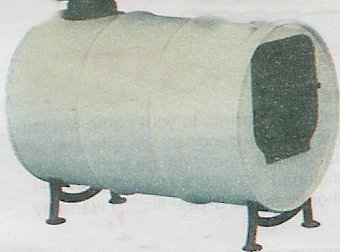
[This is an image of the Northern Tool barrel stove kit. For use as a thermal mass stove, the door should be in the center of the end of the barrel, not at the top. This image also does not show the legs attached with a long through bolt.]
The open top of the 55 gallon barrel is the front of the stove. The leg supports are attached to one another with 3 long 5/8" bolts, squared up on a flat floor, then the nuts tightened. Then the square leg assembly is placed on the barrel, holes drilled, then bolted into place. The barrel is then placed on the legs, a stovepipe bracket placed on the back (third) section of the barrel, a bubble level placed on it, and the bracket moved until it is level. At that point the barrel is marked for the bolt holes for the stovepipe bracket and drilled. Then the bracket is placed back over the holes, the bolts inserted just to keep the bracket in place, and the center section of the bracket marked where the barrel will need to be cut for the smoke to exit -- directly centered under the stovepipe bracket. To cut the steel on a 55 gallon barrel is not too difficult. The easiest way is to drill a 1/2" hole just barely inside the marked line, then use a jig saw with a metal cutting blade to cut around the marked circle. Cutting the barrel with a hand operated saw is not a pleasant operation, but can be done using a hack saw blade sent in a handle, making short straight cuts between drilled holes around the perimeter of the circle. The cut would be ugly, but work. However you cut the hole, carefully use a half-round metal file and remove all sharp burrs on the cut edge. The next step is to install the door on the removable lid of the 55 gallon barrel. The door and frame I have is cast iron, made by Washington Stove Works, and most doors and frames available are similar. The frame fits between the bungs on the lid, and the large bung is centered just below the bottom of the door frame. Next the holes are marked, the door and frame removed, the holes drilled, then the alignment checked by dropping the screws through the frame and drilled holes. With the frame held against the barrel lid, the door is opened and the opening required is marked, then the door and frame removed. Stand back and look at what you have done. Is there adequate clearance between the door opening and the bolt holes? Is the spacing the same all around? If not, reassemble and mark it again. Remember, you only have one lid to foul up, so it is best to get it right the first time. When you are satisfied with the results of your "cut line," very carefully drill a 1/2" hole at each corner of the opening, then cut on the lines between the holes. Use a half-round file and carefully remove all burrs from the cut edge on the barrel. Do not cut or drill into the center of the door cutout, as you will need that approximately 10 x 11 inch piece of heavy metal to make the stove pipe cap. The next step is to mount the door frame to the barrel lid securely, using the proper size bolts and nuts recommended for your kit. The next step is to measure the difference in diameter between your 30 gallon barrel and the 55 gallon barrel, then divide by 2. That is the depth of the mason's sand you will need to place and carefully tamp smooth on the bottom (and as far up the side as you can) in the 55 gallon barrel -- usually about 2 inches or so. Then slide the 30 gallon barrel into the larger barrel, being extremely careful to disturb the sand as little as possible. It may take several tries to get it right. Leave the open front of the smaller barrel flush with the opening of the 55 gallon barrel, with the "V" notch on the top. Add more sand around the sides from the opening, then carefully place the lid on the barrel and snap lock it in place. Reach through the stove pipe hole and push the small barrel tightly against the lid in front. When you open the door to the stove, all you should see is the inner barrel, tightly against the lid around the door frame. Now more mason's sand can be added through the stove pipe hole -- and you will be very glad you filed off the sharp burrs left when cutting the hole! Fill the entire space at the back (between the closed ends of the barrels), and put as much sand as you can along the sides, trying to get it halfway up all the way to the front. That sand is your safety heat sink! How much mason's sand will you need? Probably two 50 pound feed sacks full. Or a little more than 1/2 of a contractor wheelbarrow load. You will have made a heavy stove with great thermal mass -- an ideal stove. The draft controls on the bottom of the door admit oxygen, and the smoke must exit directly above the door through the "V" notch in the inner barrel, then trace back between the barrels along the top before exiting through the stove pipe. That means the wood being burned in the inner barrel must burn from front to back in a nice, even manner, so you have a controlled burn that will be gentle and last for a long time. To make a stove pipe weather cap, use 8" pieces of 1/2" strap steel (about 1/16" thick), and drill holes in each end. The strapping will be mounted to the top of the stove pipe, two pieces on each side, and then bolted to cheap door hinges, leaving a clearance of about 3 inches between the top of the stove pipe and the hinges. Bend the strapping so the hinges are about 10 inches apart -- the width of the door cutout from the barrel lid. Then the door cutout may be bolted to the hinges, and it will cover the stove pipe adequately to keep out rain. To clean the stove pipe, simply remove one of the hinge pins and swing the cover out of the way. Sept. 18, 2006. Note from reader Sam: From bitter experience I can offer a couple of safety hints: secure each joint with three small screws spaced 120" apart, the next thing is use "T"s instead of elbows, This will make cleaning out creosote and soot much easier and quicker. Thanks for all the good information offered on your web sits. Sam [Sam is right, and this is so obvious that I overlooked mentioning it. My stove pipes are secured with three small sheet metal screws, and "T's" are far better than 90 degree elbows...how do you remove creosote from an elbow? Pre-drill all holes in stovepipe!] But you don't have to assemble the stove now and add the sand. All you really need to do is buy the barrel stove kit, the stovepipe and elbows required, all the bolts and nuts for attachment, four 8 inch pieces of 1/2" strap steel, and a couple of cheap door hinges. The 55 gallon barrel itself should be wire brushed, washed with thinner, then spray painted with black semi-gloss Rustoleum. The kit parts are generally cast iron, so they should be coated with NAPA brand chain and cable lube so they won't rust. The legs can be placed inside the 30 gallon barrel along with the stovepipe and other parts, which is itself stored inside the 55 gallon barrel, and the lid snapped in place. The sand may be stored separately. Then your barrel stove only takes up the space of a single barrel, all the necessary parts are safely stored inside, and it is ready for assembly and use whenever you need it! Basic Parts: Northern 800-533-5545; www.northerntool.com; Item number 16160. (Illustrated above.) Vogelzang Barrel Stove Kit, Model # BK100E, $44.95. http://www.vogelzang.com/barrel_stoves.htm STANDARD BARREL KIT - $79.50. Stove pipe: usually 6", buy galvanized sections (stainless steel is best, of course) for the length required, and two (2) 90 degree angles. Keep warm and healthy. Don't forget to sharpen your hatchets for splitting kindling, get a maul for splitting wood, and have an axe and saw for cutting down a dead tree for fuel. COMMENTS FROM A READER, October 23, 2010 Hi I wanted to send you
a link to my web site because I built and
documented with pictures the build of your
thermal mass wood stove or at least how I
thought it was to be built. I wanted to
let you know that it worked great, burns a
long time on a load and keeps us warm in the
coldest days. The cook top is wonderful too.
I wanted to say thank you for the great
idea. COMMENTS FROM A READER, December 20, 2007 Hi
Miles, Btw, I got the fireplace grate at an ACE hardware store for $20. The fully loaded stove goes a bit longer than 10 hours and heats my basement, main floor living area, and second floor sleeping area. My house footprint is 24' x 34'.
|
1. Food |
2. Manna Meals |
3. Water |
4.
Sanitation | 5. Medical, health
|
| 6. Kerosene heaters and cookers | 7. Lighting | 8. Wood cooking and heating | | 9. Communications | 10. Essential Tools | 11. Home built items | | 12. Electrical; generators and power | 13. War preparedness | 14. Gardening |
RELATED LINKS:
|
|
||