|
SITE
INDEX
QUICKENING
NEWS
PREPARATIONS
1.
Food
2.
Manna
Meals
3.
Water
4.
Sanitation
5.
Medical,
health
6.
Kerosene heaters and cookers
7.
Lighting
8. Wood
cooking and heating
9. Communi-cations
10. Essential
Tools
11. Home
built items
12.
Electrical; generators
and power
13. War
preparedness
14.
Gardening
SITE
INDEX
Miles Stair's SURVIVAL
SHOP
HOME
RADIATION
INDEX & JET STREAM
PROPHECY
COMMENTARY
BY MILES
BOOKLETS
BY MILES
GUEST
SUBMISSIONS
PHOTO
INDEX
LINKS
SITE
INDEX
Miles Stair's
SURVIVAL
SHOP
|
|

SHELTER
Without adequate shelter, people
die. Really simple concept. You should
have adequate tools and supplies on hand to repair your
home structure in an emergency. But what happens if
you have to evacuate and/or your home is destroyed?
What if there is radioactive fallout?
STANDING UP TO THE BANKS
If you get foreclosed, make them produce the
note!
The government has published books on
how to built a fallout shelter, but the shelters are
small, not designed for prolonged use, and thus they
would not work for intense radioactive fallout.
Light tertiary fallout perhaps, but not intense, downwind
fallout from a nuclear bomb. And those shelters would not
be adequate at all for a "dirty nuke" or Chernobyl-type
event - but nothing short of evacuation from the area
would work in such an event.
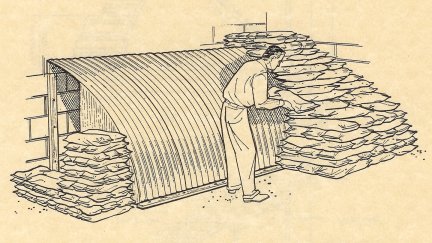
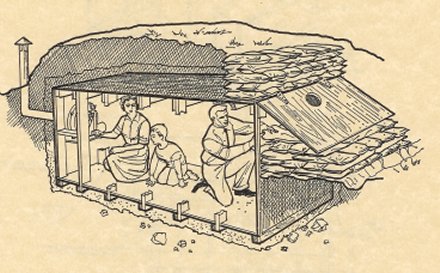
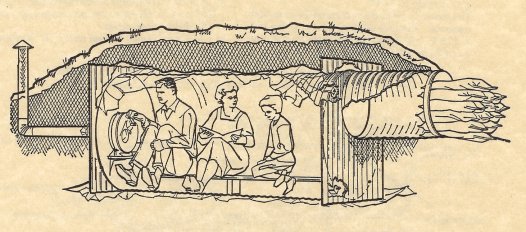
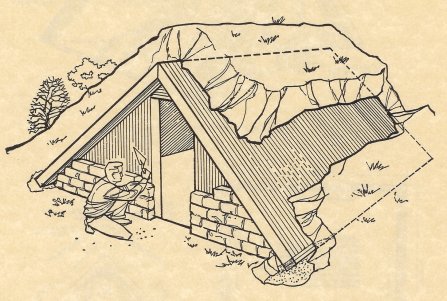
Look at some of the designs the
government has suggested and see if you think you could
live in one exclusively for two weeks. Yes, two
weeks without going outside at all. Click on the
thumbnails to enlarge them, and see if you can find
adequate room for food, water and sanitation
facilities.
If you live in a secure location and
want a real fallout shelter, you have to start building
it now, while supplies are available, and it has to be
large and under at least 2 feet of dirt or concrete for
adequate fallout protection. The air intake must
have a HEPA filter and a fan to bring in fresh air, plus
a exhaust air system that prevents the intake of
radioactive particles. Naturally the shelter would
NOT be advertised in any way to anyone, or it would not
be safe when you needed it.
The government-designed shelters shown
above assumes you will not have to evacuate to
safety. Any meaningful evacuation would have to be
to safety - not to a government mandated
location! Avoiding contact with other people would
be elemental security, and that means evacuating to a
forested area well away from any populated areas
before a mass evacuation was ordered and
Martial Law declared.
|
|
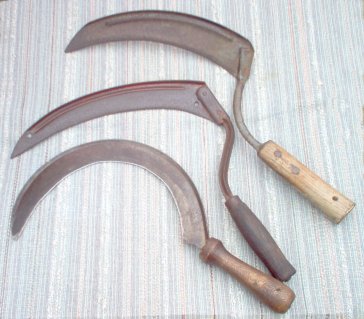
If all you have is camping
equipment, that is far better than nothing. You
would need to clear a space inside a thicket, and
cut grass and ferns for bedding material.
Sickles were designed for just that job!
The highly curved sickle at the bottom works
best. I bought it for $3.00 at a flea market.
|
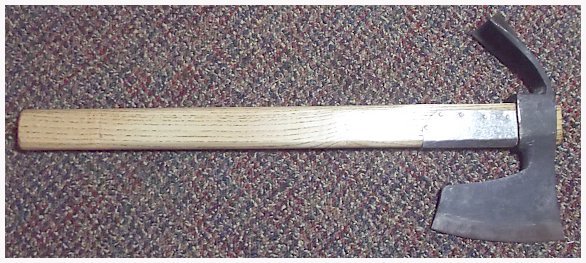
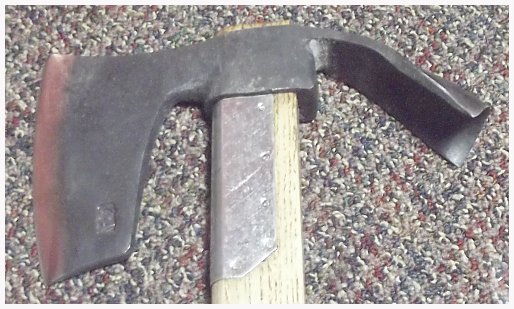
For expedient shelter building a
"Wildcrafters Hatchet" is one of the most versatile tools that one
could ask for. The tool
shown at left is perhaps the perfect "Wildcrafters"
hatchet for building smaller, expedient shelters.
The bearded axe head has a 4 1/2'' edge, the cooper's
adze on the other side with a 1.6'' concave edge can cut
bowls, gutters, notch small logs, etc. This Wildcraters
hatchet is hand forged by Ivan Stoev in Bulgaria.
It cost less than $60, including very fast delivery, in
July 2015. eBay store name is
thracian-pickers.
Camping equipment would be enough
protection from an EMP attack, but
would not provide protection against fallout. Essential
carpentry tools and woodcutting tools should be packed
and ready to go at a moment's notice if at all
possible. (Photos and descriptions of cabin building tools,
click here.)
|
|
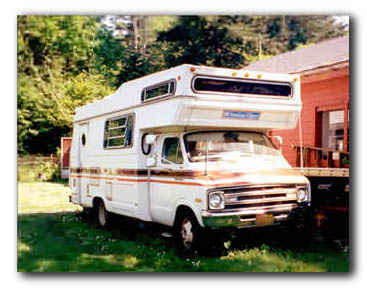
The best way to evacuate is
with a ready-made shelter - a motor home or
travel trailer. An old motor home such as
pictured above is best, as they can also pull a
trailer full of supplies and tools.
|
Good, low priced motor homes
like my 1977 American Clipper shown above are inexpensive
these days, and can often be found with very low
mileage.
A motor home or travel trailer can
still cause claustrophobia, and they offer no protection
against fallout. They can serve as a means of
having most of the necessary equipment all packed and
ready to go, however, and beating the rush - or the
government ordered route - is all important for
survival.
Once in the back woods, look for a
canyon that would not flood. A tunnel can often be dug
into a hillside, braced with sections of logs cut from
the forest, and the entrance blocked off with
sandbags. The motor home or travel trailer would
have to be covered with brush, cut off small trees, camo
tarps, whatever was available, to make your campsite
invisible. Remember, the idea is to get lost,
not found!
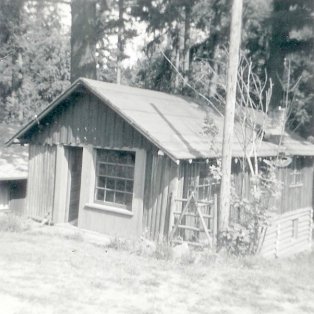
If you could not return to
"civilization" soon, and your radiation detection
equipment showed it was safe to work outside, more
permanent shelter space could be built. Mere tarps
stretched over a rope don't cut it. If you have only the
tools recommended, you could build a log cabin.
It's not that hard. My grandfather and father built
the cabin pictured above during the depression with only
the tools I've mentioned. I was born there.
The photo was taken in 1962, which explains the utility
pole, but that just shows how long a primitive log cabin
can last!
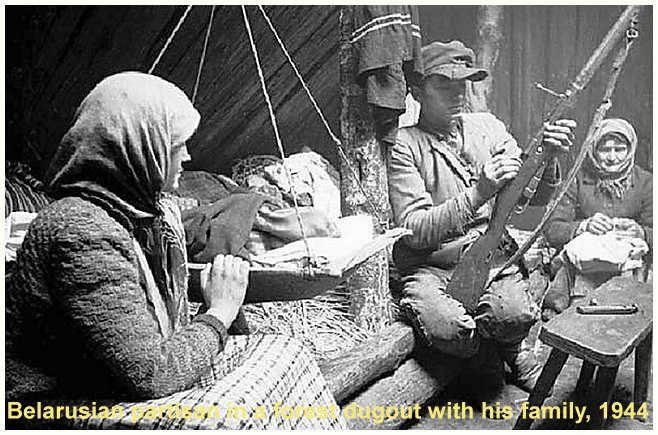
With a dugout shelter you can
survive the worst winters.
|
A "dugout" shelter, also called a ","
can keep a family safe and secure even during severe winter
weather. For more information see the Tools page -
click here.
Photo courtesy of
Partisan Resistance in Belarus |
 |
LOG CABIN
BUILDING TOOLS
Not all the tools required for
building a log cabin are shown below, but these are the
essentials. Click on the photos to enlarge them,
then use the "back" button on your browser to return
here.
|
|
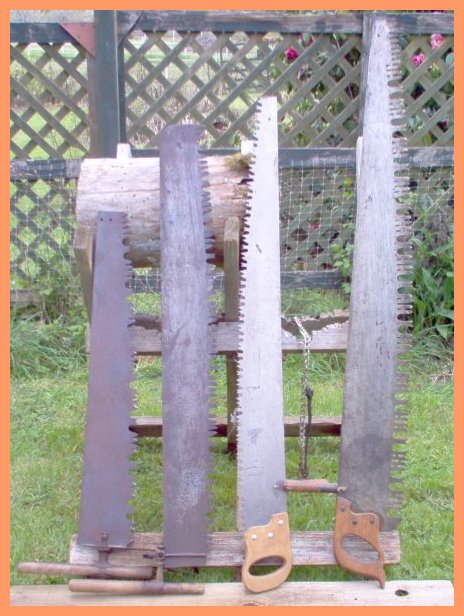
A selection of cross cut saws,
from 3 feet long on the left to a 4 foot saw on
the right. The 3 foot saw is good for cutting
notches in logs and cutting firewood sections
from up to 12" diameter logs, while the longer
saws are better for felling and also bucking
larger diameter logs.
|
|
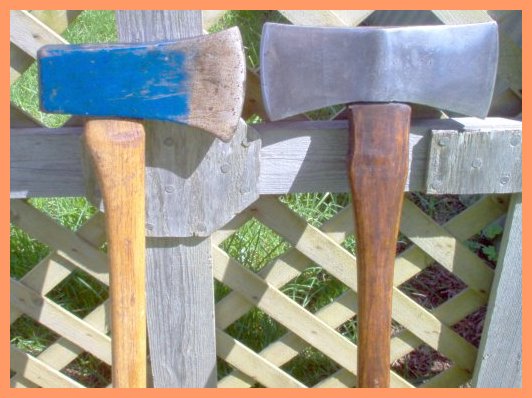 |
Single bit axe on the left is
good for chopping off limbs, and safer for the
inexperienced to use than the double bit falling
axe on the right. |
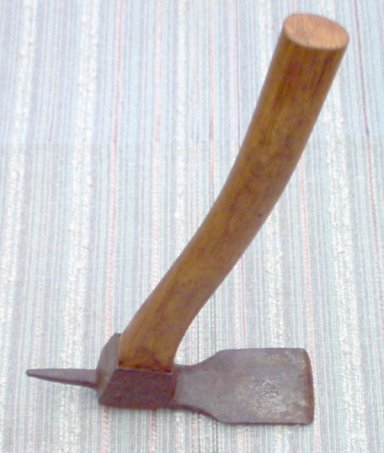 |
A small adze, ideal for one or
two handed operation to remove high spots in logs
or to cut a log flat for a door or window sill.
Also used for finishing the notches at the ends
of the logs so they interlock. |
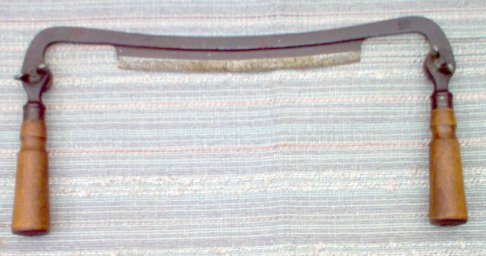 |
A draw knife makes removing bark easy, and is
very useful. |
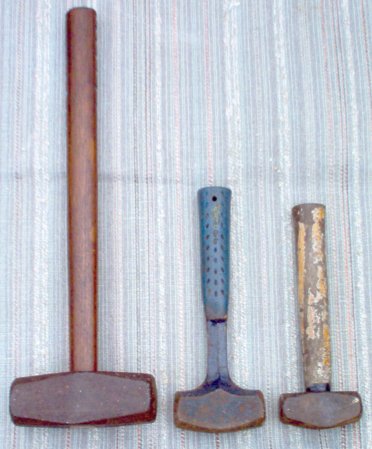 |
"Single jacks" are heavy
one-handed hammers that are vital for moving logs
just a bit so they can be fitted precisely.
Right to left: 2 1/2 lb, 3 lb, and an 8
pounder. The 8 pound is tough to use one
handed (it can be done), but the handle is long
enough for two handed use when needed.. |
 |
A froe is used with a wooden
mallet to cut with the end grain - straight down
- on 2 foot sections of cedar to make cedar
shingles for roofing. The handle allows the froe
to be twisted to "pop off" a shingle. |
RELATED PAGES >
SHELTER
Cabin Building
Without Nails
CARPENTRY TOOLS FOR REPAIR AND CONSTRUCTION
Tools - Restoration
and Rebuilding
And
How to make sheathes to keep tools sharp.

|
|
|