|
A guide to self reliant living |
||||||
|
6. Kerosene heaters and cookers 12.
Electrical; generators
Miles Stair's SURVIVAL
Miles Stair's
SURVIVAL |
GRAVITY FLOW WATER FOR LIVESTOCK AND FOWL It wasn't too many years ago that a presidential campaign slogan was "A chicken in every pot." The way things are going with the economy now, it could be a catch phrase again! Building a hen house plus an outside chicken pen for a dozen or so laying hens requires little work, once set up properly. Order baby chicks from a feed and seed store at any time from early spring to mid summer. If ordered early, by October the family will be eating fresh pullet eggs. The following spring the chickens will be laying full sized eggs in an adequate supply for your family plus extra to sell or trade: an excellent hedge against an uncertain future. It is relatively easy to store grain and set up a gravity flow water system so if the power goes out or the feed store doesn't get deliveries of grain, life for the chickens will go on without a hitch. The main problems to prepare for are a reliable source of gravity flow water and a good supply of stored grains.
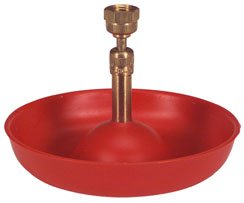
WATER: Self-filling water bowl are available for chickens, costing about $40 each. These automatically fill a little bowl which holds a couple of cups of water - good for less than half a day for a decent - sized flock in cool weather, and an hour or so in hot weather. The waterers have a half inch pipe thread connection, and most people simply set them up to fill from the normal pressure water source. If the electricity fails (for those on wells) or the water is no longer delivered by an outside source, those little waterers don't work. But the waterer doesn't need pressure to operate: they work on the principle of the weight of the water lowering the bowl against a spring and closing off a valve. As chickens drink the water, the little bowl gets lighter and rises up, and water flows in to refill the bowl. http://www.mcmurrayhatchery.com/product/automatic_water_bowls.html
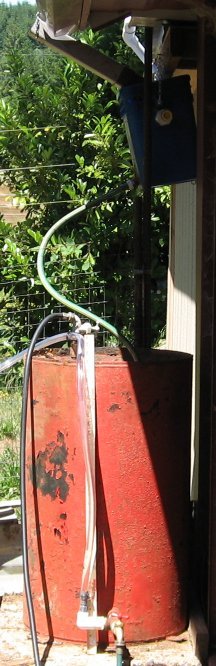
The answer is to set up the automatic waterers on a water tank, so they fill by gravity and will work without any outside assistance as long as there is water in the tank. Old water heaters that develop a leak are thrown away, yet they are perfect for this use. A leak at 60 psi is not much of a leak at all with no pressure, and it is possible to use an automotive radiator epoxy to seal a small hole in the tank. The tank should be elevated on blocks to a height of about 18 inches. Then a short piece of garden hose (about 6") can connect to the bottom drain tap on the tank, and with a 3/4" garden hose to " N.P.T. female adapter, the bowl can be connected to the tank and still clear the ground by about 4 inches. The intake fittings on hot water tanks are 3/4", so the tank can be filled with a standard garden hose from any source -- even from a roof gutter system through a filter! These parts are available now, but next year? The system described above works. I have two of them, one inside the chicken house and one in their outside pen. The tanks have enough capacity to last for about a month before they need refilling. Of course in freezing conditions the outside automatic waterer should be removed to avoid damage. In that event, I put a plastic tray below the tank hose and let it drip slowly into the tray, which not only prevents the tank from freezing but also ensures the chickens have a supply of fresh water.
With a gravity flow water system such as described above, power outages or disruptions in the water flow are simply not a concern even in good times. And this system can easily be adapted for automatic dog waterers, stock tanks, etc, so all domestic animals can have an assured supply of water no mater what happens. In the event of a terrorist EMP attack takes out the power grid, this gravity flow system could be a life saver. Those on a well would only have to run their generator to power the well pump once a month to keep their poultry water tank filled, and in the rainy season, the tank could be filled with rain gutter water run through a filter system (see photo above). Note: The gravity flow system is not entirely trouble free. There should be a fine screen stainless steel filter put in the water hose connection directly above the automatic water bowl. These screens are available in many hardware stores, as they are used for filtering water being directed to drip irrigation systems. The other problem is the valve on the automatic float valve. It is a standard tire inner tube valve. Galvanic corrosion will "rust" the valve in place, then when it breaks it cannot be replaced, so the entire unit has to be replaced. If the inner tube valve is replaced once a year, galvanic corrosion does not become severe enough to bind the valve threads, and the inexpensive valve can be easily replaced.
GRAIN: It is possible to store grains for chickens in 55 gallon drums that have a removable lid. Each barrel will hold in excess of 350 pounds of wheat, or about 300 pounds of corn. If you grind your own feed, the usual percentage to use is about 1 cup of corn and 4 cups of wheat. Because of this percentage, I have 4 of the drums full of wheat and 1 of corn. If you don't grind your own fresh grain, then stockpile chicken scratch. I prefer freshly ground grains, but most people get along just fine with plain old scratch. The grain in the drums can be preserved by using the carbide trick, or with dry ice. Freezing also preserves the grain, but that would require using 5 gallon buckets, then pouring the grain into the barrels, over and over again, as wrestling a 55 gallon drum into a freezer might prove difficult.
|
1. Food |
2. Manna Meals |
3. Water |
4.
Sanitation | 5. Medical, health
|
| 6. Kerosene heaters and cookers | 7. Lighting | 8. Wood cooking and heating | | 9. Communications | 10. Essential Tools | 11. Home built items | | 12. Electrical; generators and power | 13. War preparedness | 14. Gardening | |
|
||||