|
A guide to self reliant living |
|||||
|
6. Kerosene heaters and cookers
12.
Electrical; generators
Miles Stair's SURVIVAL
Miles Stair's
SURVIVAL |
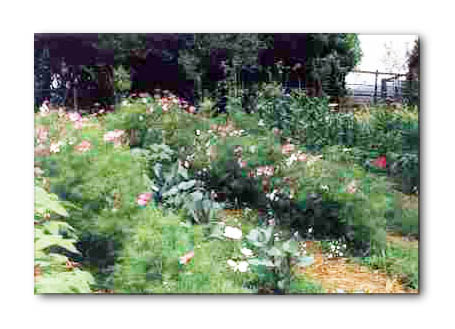
"FRENCH INTENSIVE" GARDENING French Intensive, or "double dug" raised bed gardening yields the most produce for the least area of any realistic gardening method. Originally developed for use in narrow back yards in France, these raised beds require little annual upkeep and no power tools to continue in production. The basic concept of French Intensive gardening is that raised beds are created which have humus added, and the whole bed is light and fluffy to a depth of two feet to promote fantastic root growth. The beds are typically 5 or 6 feet wide and 12 or more feet long, with 3 foot paths between the beds. Each bed is a low mound in shape, and if desired boards can be placed along the sides to maintain a distinct border, but that is not required.
Compost is created in a separate bed from chopped yard debris, grass clippings, manure (except horse manure), and kitchen scraps, then added as a top dressing every year. Establishing a raised double-dug bed is neither easy nor fun, and it takes a year before the bed is highly productive. Typically, a row is dug on the long axis of the bed using a shovel, then a heavy duty garden fork is used to break up the clods, a layer of humus added, and the trench dug deeper and added to the pile. This process is repeated backwards along the bed, during which the soil is thoroughly mixed with the humus and/or compost and broken up into fine particles. Obviously a heavy clay soil is very difficult to initially dig, whereas a sandy loam is much easier. Heavy clay soils can be improved considerably by adding a lot of sawdust and mason's sand. DO NOT use beach or river sand! Mason's sand, being crushed granite, has sharp edges and actually loosens the soil. A lot of sawdust or wood chips, chopped straw, chopped leaves (except Walnut), etc, make a heavy clay soil lighter and more friable, but also consume nitrogen as they decompose. A cup of ammonium nitrate per 10 feet of row replaces the lost nitrogen. Another excellent soil amendment is vermiculite, which can be purchased relatively inexpensively from concrete suppliers. Vermiculite is basically puffed granite particles, so it holds moisture extremely well and is not biodegradable. Once established, French Intensive beds require little additional work, and their main limiting factors in producing high yields are sunlight and water. Because the beds are densely planted they are effectively interplanted,* so plant spacing is important, and growing similar height plants next to one another is a good idea. All gardens require about 1 inches of irrigation water per week, and French Intensive beds require no less. This can be "grey" water, misted sprayers, whatever, but should be applied until the surface of the ground is "shiny" for a few seconds. Frequent light watering does not encourage the water to penetrate to a great depth, yet with 2 foot deep beds to encourage deep root growth, deep watering of French Intensive beds is mandatory. Planting French Intensive beds is a unique experience. Instead of a single long row as in "normal" gardening, the rows should be at least a foot to 3 feet wide and run across the bed. Now you can see why the paths should be about 3 feet wide: you have to kneel on the path to plant to the middle of the bed, then go to the other side, kneel, and finish planting the "row." Individual plant "spacing" in normal gardening is accomplished by thinning the rows. In French Intensive gardening the spacing is accomplished by seeding at the correct space while planting. See the "thin to" guide in this booklet, or look at the recommendations on the seed packet itself for details. One of the least understood aspects of gardening is that of capillary action of the garden soil. It is a proven fact that compressed earth has a better capillary action than undisturbed soil. That is why gardening books tell you never to walk between rows in a regular garden, as that encourages weed growth. And of course people are told never to step in a French Intensive bed and thus compress the soil. But the capillary action is absolutely necessary to bring water up to the roots of growing plants to promote good and deep root growth. In regular garden rows, it is easy to roll a heavy 2 or 3 inch wide weighted wheel (mounted on an axle and handle) down the row directly over the freshly planted seeds, which will then promote deep root growth along that line. The spaces between the rows are than rototilled to eliminate footprints prior to the initial watering. With French Intensive gardening, the compressing of the soil directly around the seed can be done using a 2 inch round object such as a water glass. The seed is planted, then the glass (or whatever) placed over that spot and the soil compressed an inch or so. The now-compacted soil will draw moisture up directly beneath the seed, and the roots will be encouraged to grow straight down and deep.
*INTERPLANTING: Many of the fast-maturing vegetables (leaf lettuce, mustard greens, spinach) may be planted among the seedlings of slow-growing vegetables (peppers, eggplants, or tomatoes).
------------------
|
|
|||