|
SITE
INDEX
QUICKENING
NEWS
PREPARATIONS
1.
Food
2.
Manna
Meals
3.
Water
4.
Sanitation
5.
Medical,
health
6.
Kerosene heaters and cookers
7.
Lighting
8. Wood
cooking and heating
9. Communi-cations
10. Essential
Tools
11. Home
built items
12.
Electrical; generators
and power
13. War
preparedness
14.
Gardening
SITE
INDEX
Miles Stair's SURVIVAL
SHOP
HOME
RADIATION
INDEX & JET STREAM
PROPHECY
COMMENTARY
BY MILES
BOOKLETS
BY MILES
GUEST
SUBMISSIONS
PHOTO
INDEX
LINKS
SITE
INDEX
Miles Stair's
SURVIVAL
SHOP
|
|
SWARM
CONTROL THROUGH HIVE MANIPULATION
To fill its nectar sac, a worker bee
may make between 1,000 and 1,500 individual floret/flower
visits. About 60 full sac loads (over 60,000 flower
visits!) of nectar are required to produce a thimbleful
of honey. For a large hive to store two pounds of honey
requires about 5 million individual bee journeys. For a
hive with 30,000 workers to make those 2 pounds of honey
requires about 167 journeys per worker. A hive with
60,000 workers needs only 83 journeys per bee to make 2
pounds of honey. Numbers count - heavily.
When a hive swarms, up to 60% of the
bees leave the hive. And the swarming occurs just before
or during the prime nectar flow, leaving no time for the
hive to rebuild its numbers. That hive will produce
little if any surplus honey that year. If you want honey
production, you don't want swarming.
Bees swarm for a variety of reasons.
Swarming is nature's way of dividing colonies to create
new ones. Thus in the wild, swarming propagates the
species. When bees swarm from a hive it is a planned
event to correct problems of overcrowding, starvation, or
other internal hive problems, but feeling crowded is the
primary cause of swarming. Swarms generally emerge on the
planned day between 10 AM and 3 PM (maximum sunlight),
swirl in the air, then cluster on something such as a
limb or bush, generally in the shade. There they wait
until the scouts agree on a new hive location.
|
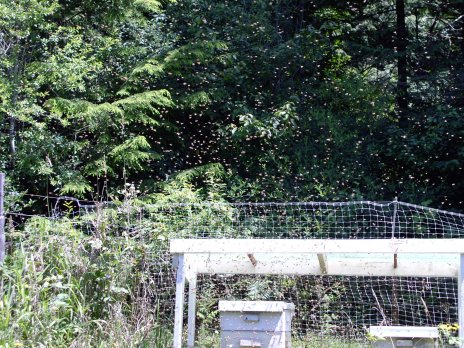
|
All those white dots in the
air in the photo at left is a swarm descending
into the bait hive on the left. I waded
into the swarm to take this photo on June 1,
2004. The bait hive was deliberately placed
on a known flight path for swarms coming from the
woods shown behind the hives. |
If you want to increase your hive
totals, chasing swarms from your own hives is usually not
the best way to do it, for too often the swarm, or later
"casts," will get away. It also means you are genetically
selecting queens more prone to swarm. Making a "split" or
"divide" will often solve the swarm problem, and safely
expand your colonies under controlled circumstances. And,
it is not too difficult or time consuming.
Swarm control is usually a variation
of the famous Demaree system, which involves the
continuous presence of empty drawn comb in the brood
nest. Just one or two empty combs will inhibit swarming,
if those combs are placed at the right time in the brood
nest.
Maintaining adequate room in the brood
chamber involves hive manipulation in one or more ways,
such as reversing the hive bodies of the brood chamber,
making a "split" or "divide," adding supers at the right
time, adding more room with a slatted rack, and possibly
requeening the colony.
REVERSE HIVE
BODIES
Perhaps the most important hive
manipulation to control swarming is to reverse the hive
bodies in the spring. In the Pacific Maritime Northwest,
the usual best time to switch the brood chambers around
is about March 15th to April 15th. In the East where the
winters are colder and spring is therefore later, Dr.
Morse recommends April 15th to the first week in May.
The instinct of the honey bee is to
move its cluster upward during the winter into the food
(honey) stored for that purpose. But the queen generally
does not move back down. Come spring, the brood chamber
is about as high as it can go. Adding a queen excluder
and supers does nothing to enlarge the brood chamber, so
the bees will feel crowded even with 9 or 10 frames of
drawn-- but empty--comb right beneath them. By reversing
the hive bodies the queen will happily run right up into
empty drawn comb and lay eggs by the thousands. When
reversing the hive bodies it is always a good idea to
clean or replace the bottom board of wax particles,
pollen, etc. The easiest, fastest, and best method is to
quickly replace the bottom board with a clean one,
replace the slatted rack, then the reversed hive bodies.
The used bottom board can then be washed, scrubbed,
repainted/repaired if necessary, and then used again to
replace another overwintered - and therefore dirty -
bottom board.
DIVIDE AND
CONQUER
Divides, just like swarms, should be
planned events. If you are not going to increase your
colonies, you must decide if you are going to give a weak
hive some brood from a super-strong one, thus controlling
swarming in one while building up another for a better
honey crop. Or perhaps you would take frames of brood
with adhering house bees and combine them with a weak but
queenright colony using the newspaper method.
Perhaps you want an extra nuc or two
to make up for winter losses, or for an increase. Then
you should first have built a new hive stand, installed
level side-to-side, with a slight drop of " to3/4 inch
toward the front, meaning the South or Southeast. And you
will have to decide if you want to let the bees make
their own queen, or if requeening, make arrangements to
buy new queens. And decide what kind of queen, and from
whom. Once those issues have been decided, you would pick
a day to divide just as the bees do when they decide to
swarm: warm, sunny, light or no wind, and from 10 AM to 3
PM. The field bees would be out, leaving the younger
house bees in the hive. Often house bees will not fight
with those from another colony, so you could combine
brood comb with adhering bees from several hives in
making the nucs.
If you find swarm cells when making
the splits, you must decide if you will use some of them
for a new queen, or scrape them off. Supercedure queen
cells, usually located 2/3rd of the way up in the middle
of drawn comb, are often best left alone, as the bees are
requeening themselves in a very controlled fashion which
does not involve swarming.
A strong divide for increase should
consist of 9 or 10 frames. The outside 2 would be
honey-filled. The next two would be pollen and honey.
That leaves 4 or 5 frames for brood, and one of fresh
eggs just in case an introduced queen is not accepted.
Some experienced beekeepers who requeen make sure the old
queen goes with the nuc, and requeen the old hive. This
method builds up the nuc much faster, as the old queen is
(you looked to make sure!) reliable, laying lots of eggs
in a good pattern. Dr. Morse recommends this method. Dr.
Morse will either requeen the old colony or let them
raise their own queen. If swarm cells are not present
then he makes sure fresh eggs from his favorite queen are
available in the old colony.
Finally, a strong nuc as described
above should be watched carefully. It will not have many
field bees, so if the weather turns inclement they will
need to be fed. Feeding of 60-40 honey/water is best,
followed by the same percentage of sugar/water as a last
resort.
|
|
|

