|
A guide to self reliant living |
||||
|
6. Kerosene heaters and cookers
12.
Electrical; generators
Miles Stair's SURVIVAL
Miles Stair's
SURVIVAL |
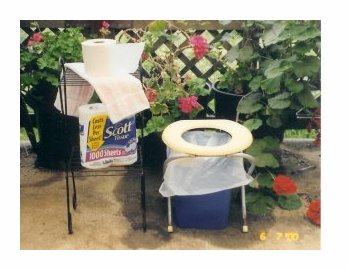
SEWAGE DISPOSAL This usually not thought of or dealt with subject must be covered thoroughly, as failure of the public water or sewer waste systems pose a very serious problem. Your home toilets will no longer flush! They might even back up into your bathroom from the sewer line running down your street. Improper disposal of human waste is a sure cause of disease, particularly cholera and typhus, and I want you to survive. BROKEN SEWERS AND SEWAGE FLOODING It doesn't take an earthquake or natural disaster to knock out the sewage system in the cities. If the electric power goes out, the pumping stations fail to operate. In the summer of 1999, one California city tried a Y2K test of its system, and the result was millions of gallons of raw sewage flowing through Balboa park. The worst danger, though, if that those homes on the lower ends of the sewage pipelines get all of the sewage flow: toilets back up, basements become flooded, entire subdivisions of homes rendered unlivable. There are two ways to prevent that problem: a one-way flap valve, or a gate valve, installed in the 3 or 4 inch main sewage line leading from the home. The flap valve is automatic, working simply by gravity. The gate valve requires that someone be there during an emergency, go into the crawl space or basement, and turn the valve shut. There are those who claim that the flap valve itself can become a sediment trap and cause a sewage flow problem, but that is a theoretical concern, whereas the threat of a sewage backup can be very real. Either type of valve can be installed by a plumber, or even by a semi skilled homeowner. There are three stages in the disposal of sewage: emergency shelter living; semi-permanent toilets in the case of societal failures; and, more permanent latrines or toilet facilities. PERMANENT TOILET FACILITIES A permanent toilet facility will function independent from municipal utilities. Now you know why I emphasize a gravity flow water system and country living with an independent septic system. There isn't much that can go wrong with such a system, even if the electricity goes out. A few years ago we were at a New Year's eve party, and everyone got "sick" from something we ate. We left early (for obvious reasons), and as we were driving home a tree fell across power lines miles away and took out all the electricity (winter storms are common in the Pacific Maritime Northwest). A small flashlight got us safely into the house, kerosene lamps were lit, and I turned off one valve to isolate the well pipeline (to keep pressure in the system), then turned another valve "on" to open the gravity flow water system. In 5 minutes we were back in business with lights and running water. I placed some more wood in the wood stove, and soon we were warm. We were still sick, but we were comfortable in a warm, well lighted house, and the toilets worked as always. When we got up in the morning, coffee was made and breakfast cooked on a kerosene cooker. At noon the electricity came back on, and I turned off the gravity flow system and opened the valve for the well system: because I had shut it off before the pressure dropped, I didn't have to go out in the rain and pressurize the tank again before it would work. There was virtually no inconvenience for us caused by the power outage. Meanwhile, back at the house with the party, there were no lights except a few candle stubs and one (1) flashlight with half dead batteries, no running water, and there were a dozen people lined up to use a non functioning toilet. They did not have a happy New Year's Eve or New Year's Day! Adapting your home with an alternative water system, kerosene lamps, plus food and other supplies means you don't have to worry about the small day to day emergencies that occur: you simply adapt and continue living under virtually normal conditions. Those dependent upon public sewer systems may want to prepare in advance with a composting toilet: they work, and you can either build your own system or purchase a commercial unit quite inexpensively (Do a web search to see if what you find is fits your needs.). Homes with a working septic system but not a reliable, gravity flow water system will find the septic system does not work without the input of a lot of water through the toilets...they too could benefit from a composting toilet. See Lehman's Hardware for their selection of composting toilets for examples of commercially available composting toilets. Those people fortunate enough to have both a septic system and gravity flow water will be able to simply use what they already have - it works automatically. Be sure your drainfield is clear and your septic tank is clean now, while you can. SEMI-PERMANENT TOILET FACILITIES Now we are talking outhouses. Here a deep hole is dug, say 4 feet square and 8 feet deep, and a wooden building with a real door is built around the hole. The pit is partially planked over, with a box or platform bench in the back in which a hole is cut for sitting down. Outhouses must be ventilated, and window screens are a necessity. It is easy to forget proper sanitation rules with an outhouse, but they must be followed to ensure safe and healthy operation. There should be a hinged board which covers the hole in the bench, and it should be down when not in use. The toilet "seat" should be cleaned and disinfected at least once a day with a strong chlorine solution. Once a day, some lime should be thrown down the hole, which will help eliminate odors. Soap and water must be available, even if only in wash basins. If hand towels or linen must be used for sanitary purposes, a heavy plastic bucket with dilute lye water or bleach solution should be used for soaking clothes (similar to a baby's diaper pail), and the linens washed daily. TEMPORARY TOILETS In the military, these are called trench latrines, or straddle trenches. A foot wide, two foot deep trench is dug. Curtains of black plastic sheeting, canvas, bamboo and/or wood, or burlap can be erected to provide privacy, but normally no seating arrangements are provided. After use the material in the trench must be covered immediately with earth. Once a day the bottom of the trench should be covered with oil. Fuel oil, crude oil, used engine oil, diesel, kerosene, it doesn't matter, as they all act as a larvicide to control flies and other insects. When the trench is half full, it should be covered with soil, and then another trench dug. EMERGENCY SHELTER LIVING Nuclear fallout or a complete breakdown in societal conditions would necessitate living in a confined shelter for several weeks. The problem of sewage disposal must be undertaken in a careful manner. Perhaps the most expedient method is to have a portable toilet seat (the kind that has folding legs) placed over a 5 gallon bucket. The bucket should be lined with a tall kitchen trash bag, and closed between use. When the bag is partially full, it should be closed tightly with a twist tie and stored in a sturdy 15 gallon bucket or something similar that can be tightly closed. The reason, of course, is that the sewage must stay with you in the shelter until it is safe to come out. Then the entire large container must be carried outside and the contents placed in a deep pit, covered with lye or lime, then a layer of soil at least 2 feet deep shoveled over the entire thing.
------------------
|
1. Food | 2. Manna Meals | 3. Water | 4. Sanitation | 5. Medical, health |
| 6. Kerosene heaters and cookers | 7. Lighting | 8. Wood cooking and heating | | 9. Communications | 10. Essential Tools | 11. Home built items | | 12. Electrical; generators and power | 13. War preparedness | 14. Gardening | |
|
||