|
A guide to self reliant living |
||||
|
6. Kerosene heaters and cookers
12.
Electrical; generators
Miles Stair's SURVIVAL
Miles Stair's
SURVIVAL
|
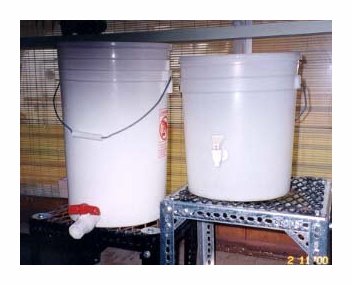
MAKING LYE WATER The easiest method of making lye water is to drip water through wood ashes. Sounds real easy, but it is a bit more complicated than that. One method that combines new technology with old is to use a 10 foot length of plastic rain gutter, complete with a cap on one end and a down spout connection on the other end, and fasten it to fence posts about 4 feet off the ground. The down spout end should be about an inch lower than the capped end. Fill the gutter with an even layer of wood ashes, not tamped down or compacted. Water sprinkled on the ashes will filter out the lye and drip out the down spout end. Under the down spout end of the rain gutter should be placed two plastic buckets. The bottom one collects the lye water, and should have a valve installed in the bottom to drain the lye water. The lid for the bottom bucket should have a half-dozen holes drilled in a circle about 6 inches from the middle of the lid, each hole being about " in diameter. The bucket above that should have matching holes drilled into the bottom, so any lye water will run out the bottom, through the holes in the lid below, and collect in the bottom bucket. Straw is packed tightly into the top bucket, with its lid holding down the straw. In the lid for the filter bucket, cut a hole that matches the down spout, and place a length of down spout between the rain gutter and the bucket.
What you now have is an automatic lye water machine. Because the system is "closed," rain water cannot dilute the lye solution, but rain can be used as the source of water for the ashes, so lye water can be made in the winter. During heavy winter rains, a board can be placed over all but the first foot or so of the gutter, which will limit the amount of water intake and still allow what rain falls into the first foot to filter through all of the ashes to the exit down spout. The straw in the filter bucket acts exactly as a filter, removing any contaminants and purifying the lye water. Remember that the composition of the wood ashes determines the quality of the lye produced. Soft wood ashes yield a lye that will only produce soft soap. Hardwood ash lye will make harder soap for bars, and the best ash of all is from seaweed, such as kelp. Kelp ash lye produces an extremely hard, durable soap. And here you thought the British fought the Falklands Island war over sheep! The finest kelp ash in the world comes from the sea around the Falklands. Every part of the "automatic lye machine" listed above is made from plastic. Do not use any metal in the fabrication, particularly a reactive metal such as aluminum, as lye really is "caustic," and will quickly eat right through many metal containers. Lye water may also be used for washing non-carpeted floors, followed by rinsing with cold clean water. The lye water will oxidize and sanitize the floor: any bacteria or insects will be killed. It can also be used to sanitize outhouses and latrines. Just be sure to wear rubber gloves and always use cold water to rinse, as hot water makes lye rather active.
------------------
|
|
||