|
A guide to self reliant living |
||||||
|
6. Kerosene heaters and cookers 12.
Electrical; generators
Miles Stair's
SURVIVAL
Miles Stair's
SURVIVAL |
EFFICIENT CANNING OF FRUIT JUICES Most of you who have made your own cider and other juices know that straining the raw product to obtain a pure juice can be time consuming and laborious. I have through trial and error developed the system below which keeps excessive amounts of sediment out of the canned juice product, and it is also much more efficient than any other system I have seen. The Filter Bucket It is often possible to find tall buckets from restaurants (used for bulk foods) that have the same diameter as a standard 5 gallon bucket, but hold 7 or 8 gallons. You will need one of those, and they are most likely found at the same place you find sturdy 5 gallon buckets, a local donut shop or bakery.
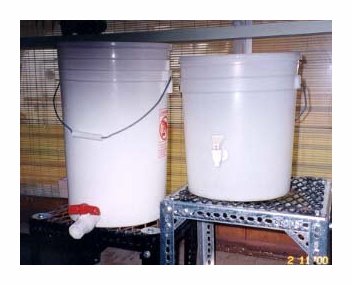
Filter Bucket at left Drill a 3/4 hole in a side of the tall bucket where the handle falls, just barely above the bottom. Swing the handle to the back side of the bucket to get it out of the way. Then fit a 3/4", short plastic nipple in the hole, enlarging the hole with a round wood rasp as needed to get a tight fit. Fit a 3/4" plastic gate valve to the nipple on the outside of the bucket, and on the inside use a 1 1/4" to 3/4" female reducer as a nut on the inside. A thin "O" ring of the correct diameter can be placed between the nut and the plastic bucket on the inside, and the nut compresses the "O" ring correctly, thus forming a water tight seal. These are all common parts found in most any hardware store. Now you have a bucket from which you can pour a filtered liquid through the gate valve, and not have to lift the bucket and slosh it around while pouring. The filter to use is a standard 5 gallon nylon paint filter, fine grade. The filter is large enough to drop inside the bucket, and the top pulled out and over the rim and down past the top two reinforcing ridges on the bucket. These filters are quite durable and will last for years if treated with care. They are made from pure nylon, have no additives, and are completely safe for this particular use. All of these items are available from any True Value hardware store worth its salt. But now comes the problem. The filter will not stay in place when liquid is poured inside -- the weight of the liquid pulls the filter to the bottom of the bucket, and that is not desirable. That means you have to securely tie the filter to the bucket. The easiest way to do that is to use cotton clothesline rope, as it is very smooth and soft and will not abrade the nylon filter. You start with 5 feet of rope, and tie about a 2 inch loop in one end. Then approximately 26 inches from the loop you make another 2 inch loop in the rope, which will leave a "tail" on the rope of about 28 inches. ---------(28")--------------0---------------(26")------------0 To use this rope, wrap it around the bucket (over the filter) in between reinforcing rings near the top of the bucket, put the "tail" through end loop and pull the rope tight, then put the tail through the middle loop, and tighten again. You will find you can tighten the rope nicely, and "squeeze" the bucket between the two loops, so the filter is held tightly while not being harmed in any way. Between the loops, push up a section of the tail of the rope, put a loop through that, pull tightly, and you have a secure knot that can be loosened simply by pulling on the end of the "tail." Now the bucket, complete with filter and spigot, can be placed on a table with the gate valve protruding over the edge, and freshly made juice poured in the top. Replace the lid to the bucket, and grind, juice, or squeeze more juice, and add it the to the bucket. The filter removes the large particles, and can handle about 20 gallons of raw juice before it needs to be removed and cleaned. For mass production, two filters can be employed, one being washed and dried while the other is in use. When 3 to 4 gallons of filtered juice are visible in the bottom of the bucket, put a pot or pan under the gate valve and twist the handle, and the filtered liquid flows nicely with full control over the volume of flow desired. The Sediment Bucket That filtered liquid needs to sit and so very fine particulates will precipitate to the bottom, leaving wonderfully clear, pure juice above the sediment. For this purpose I installed a small spigot about a quarter of the way up a 5 gallon bucket.
The sediment bucket should be placed where it need not be moved nor jostled, so very fine particles will sediment via gravity to the bottom of the bucket -- below the spigot! Drain the filtered juice from the strainer bucket into a large pitcher and pour it into the sediment bucket, then wait a half hour or so. Now absolutely clear, pure juice can be drained out of the bucket above the sediment layer, and it is ready for canning. When the sediment reaches the level of the spigot, it can be poured on the compost heap, the bucket hosed out, and the process resumed. Actually, it is much harder to describe this system than to build or use it! With a total cost of about $10.00, and a useful life measured in decades if stored away from sunlight, this system is certainly cost effective. And the end result is perfectly pure, filtered canned juice, which may be stored safely on a shelf, its health and beauty captured in quart or half gallon sparkling jars to enjoy for years.
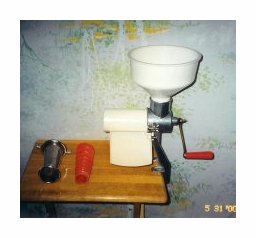
Some "juices" should be canned without the use of the filter or sediment buckets, of course, such as applesauce and some squashes. This produce is chopped into chunks, boiled until soft, then run through a "Squeezo" strainer. Even though they are thick liquids, they can be put into the bottling tank (below), heated over a kerosene stove, and poured directly into hot canning jars for home canning. The Bottling Tank Most people will stop with just these two modified buckets, and use a stainless steel stock pot to heat the pure juice before canning. The juice must then be dipped out of the stock pot (gravy ladle) and poured into dry heated canning jars, a lid and ring added, and the jar given a boiling water bath canning for 20 minutes.
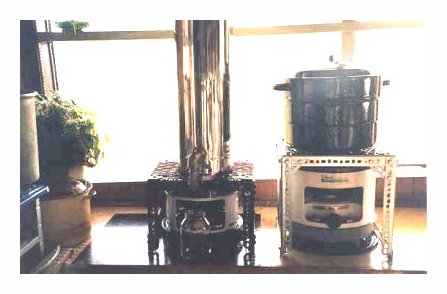
For those who really want a "Look Ma, no hands!!! type of canning system, very fast and efficient and that does not involve ladle dipping of hot liquid, a heating tank with a bottom drain can be built that works like a charm. I used a stainless steel tank, 8 inches wide and 36 inches tall, that began life as a water "blanket" filter and was discarded. I had a sheet metal shop drill through the side near the bottom and weld on a 3/4" stainless steel nipple. To that I added a brass gate valve and a 90 degree angle, so liquids can be heated right in the stainless steel tank sitting on a cooking stand over a kerosene stove, and the gate valve opened to fill canning jars directly from the valve: the liquid need not be ladled and splashed at all.
With this system, the juice can be made, run through the filter bucket, then the settling tank, be heated in the stainless steel tank over a kerosene stove, the jars filled and then put in a water bath canner sitting on another kerosene cooker, and the whole process is so efficient it is almost like an assembly line! Alternatively, you can use a steam canner instead of the waterbath canner to save time and energy. Click for Steam Canner Review by New England Gardener.
MORE ON CANNING JUICES FROM New England Gardener The Mehu-Liisa steam juicer is an ideal way to extract and process relatively small amounts of fruit juices. Mine holds 10 liters of fruit, or about 11 quarts. The hot juice can be drained directly into sterilized bottles or jars and sealed. Then it only needs to be stored in a cool dark place, like any other canned food. Today I used mine to make raspberry juice. With this fruit, I got about 2/3 as much juice as the whole fruit I put in the juicer, more than 6 quarts. This juice is very flavorful, and I dilute it with an equal amount of water before drinking, and it still tastes much more like the fruit it came from than any store bought juice I ever had. Lehman's Hardware offers this juicer as well as rubber stoppers for old fashion soda or beer bottles with unthreaded tops. Ordinary canning jars work fine too. The juice is also perfect for making pan cake syrups by adding an equal volume of sugar, or in any jelly recipe. This unit can also be used for steam cooking, blanching, reheating or defrosting. - New England Gardener Mehu-Liisa steam juicer instructions, in pdf format. NEW: For those
of you that can juice in canning jars the above cap can be
used on wine and whiskey bottles which I am sure you can
pick up from restaurants and recyclers. The way they seal
is you pour your hot juice in the bottle, slide the cap
over the opening and down the neck of the bottle and as
the juice cools it creates a suction drawing the cap down
into the inside neck of the bottle and sealing it. And
they are reusable. I have personally used these caps on
whiskey bottles to can elderberry juice so I know it
works. from Jim Taylor ------------------
|
|
||||