|
A guide to self reliant living |
|||||||
|
6. Kerosene heaters and cookers
12.
Electrical; generators
Miles Stair's SURVIVAL
Miles Stair's
SURVIVAL |
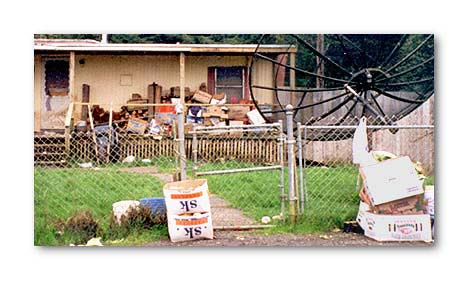
FLY CONTROL A fly and rat heaven shown above. The best method of fly control is to eliminate their breeding in the first place. Unless breeding conditions are especially favorable, adult fly populations will not increase rapidly when temperatures are below 60 degrees F. Therefore large scale fly control programs will generally be warranted only during the summer months. A good general sanitation program will probably be all that is necessary to keep the fly problem at a minimum during the remainder of the year.
Window screening is of prime importance, but even a screen door will not keep a determined fly out because of the numerous times a day people come in or go out: the fly waits, then flies in when you do. So we are now reduced to the flyswatter...not a pleasant task to swat that fly off your coffee cup. Indoors, flies can be killed through the use of common fly spray, a synthetic pyrethroid, which is formulated specifically for flies and does not injure humans. The room only needs to be evacuated for a few minutes while the spray kills the flies, then the windows (screened) may be opened and the room ventilated. Fly control spray around exterior doors works extremely well, and is available from most feed and seed stores: they are used extensively in and around horse stables and cow barns. All sewage disposal facilities must be constantly maintained to eliminate fly breeding. If latrines or outhouses must be used, ventilation must be provided but securely screened, all exposed surfaces washed daily with lye water, and the pit or trench contents sprinkled with lime, kerosene, or used engine oil. Any type of oil is a very good larvicide.
Organic Phosphates are rather deadly insecticides (nerve gases!), but can be used as bait for flies or used as a wettable powder and sprayed on areas which require complete coverage. Sevin (carbaryl) or Malathion can be sprayed following the directions on the container, or mixed with 25% sugar and a little water to make a paste, then set out for flies. Be absolutely sure to keep these products away from small children! Insecticides are poison and special care must be taken to prevent:
Animal wastes should be collected and buried under at least 4 inches of earth. Manure can be used in making a compost pile that also utilizes household organic material, then covered with a layer of dirt, plus grass clippings or straw, etc.. The result will be friable, rich compost to use if gardening is possible, and the layer of dirt will keep flies away. ------------------
|
|
|||||