|
A guide to self reliant living |
||||||||||||
|
6. Kerosene heaters and cookers
12.
Electrical; generators
Miles Stair's SURVIVAL
Miles Stair's
SURVIVAL
|
PLAYING WITH TEMPERATURES Temperature - heat and cold - changes the actual physical properties of things, and is easy to use to help us make or repair things, or even make our own tools.
Heating steel makes it expand
slightly, while rapid cooling makes it shrink, or
contract, slightly. Using those principles the pioneers
could put a steel rim onto a wooden wagon tire in the
middle of nowhere. The rim was formed to be slightly
smaller in diameter than the wheel, then heated in a
campfire to a red color, quickly placed around the wooden
rim, then shrunk to a tight fit by splashing the hot
steel with cold water. The steel would be brittle from
the cold water quench, so better wagon smiths quenched
with oil of some kind, even lard or fat. Primitive welding can be done with the process of hot swaging. Say you want to make a steel band to reinforce a tank. The band is first annealed, then swaged round to the final diameter when cold. Then the overlapping ends of the band are heated cherry red and hammered together on an anvil while hot. The process may have to be. repeated several times, but the ends of the band will become "welded" together and stay firmly attached. A gasoline or propane torch can be used for "spot" heating for this purpose, thus confining the heat to a specific spot. If a fire is used instead, tongs or vice grips must be used to hold the steel while swaging, as the heat cannot be localized as with a torch.
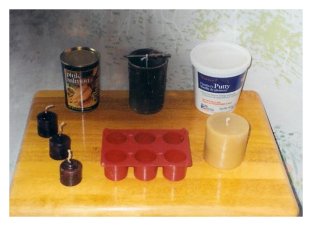
Working with wax making candles or as a beekeeper? A tea kettle can be your best friend. Take wax, for example. It melts at 145 F, so boiling water (212 F) can melt it easily. A brief dip in hot water loosens a candle from a mold, and soaking in boiling water will clean the mold. Have a candle gang mold and the candles are stuck? Freeze the mold, and the wax and mold will contract. Thawing expands the mold faster than the wax, and the candles should come out easily. If not, a little boiling water from a whistling tea kettle over the mold will expand the mold and the candles will come out easily. Then pour boiling water into the mold to dissolve whatever was causing the candles to stick. See more in Making Candles. Boiling water poured through a honey
filter turned inside-out will melt the wax particles and
residue right off. Encounter cartridge brass that is too hard (old) and getting split necks, and you need that brass for reloading? Anneal the neck and shoulder area and the brass will become soft and last another 20 rounds or so before annealing is again needed. The details of annealing cartridge brass can be found in Reloading .410 shotshell cases.
|
|
||||||||||


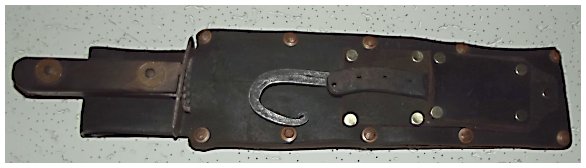
 A
very useful
railroad spike!
A
very useful
railroad spike!